https://picasaweb.google.com/116253494913081133936/KazaAlbum?authkey=Gv1sRgCPv6hsjywY7qQw#5656063801185291170
Day 1
8 August
We sheepishy handed over an enormous pile of unpleasant laundry from our last week o sweat drenched trekking, and headed off to find somew here for breakfast.
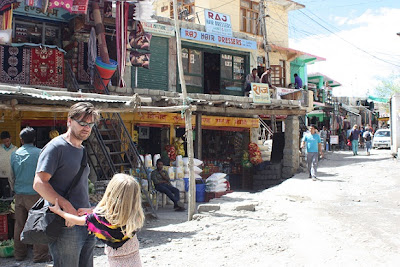
Kaza is used to foreign travellers, with a number of guest houses and with restaurants that served cornflakes and muesli for breakfast and pasta and pizza as well as indian, chinese, and israeli food, but it is smaller, much more remote and primitive than Manali. We had running water in our hotel, (which we think came from a tank of rainwater on the roof), but all the restaurants and houses had a tub of water that they kept filled by carrying cans of water from a hand-pumped well in the centre of town. If you wanted to wash your hands in a restaurant, the waiter would stand next to you with a jug of water, pouring over the balcony as you soaped and rinsed. If you asked for the toilet - they would look confused and signal vaguely outside the restaurant - toilets were rare in Kaza, you were expected to find somewhere in the rubbish strewn wasteland behind the houses. Electricity was only occasional and residents had learnt to live with it using torches and candles. Traveller oriented menus were often not backed up by supplies and we learnt to check what was available before spending too long deciding. Fruit was particularly scarce the whole time we were there, despite tantalisingly tempting mango and kiwi lassies offered on the menus.
The town is split in two by a wide stone laden riv er bed - completely dry except for a tiny apologetic stream of water that weaves its way betwen the heaps of rubbish and scavenging dogs, on its way to the churning Spiti river, leaving one one side the old town of Kasa, with its ancient whitewashed houses along the winding main bazaar street, and on the other, the new town, with its concrete residential areas and corrugated steel roofs, hospital, petrol pump station and local government departments.
Dreary as it was in the rainy weather that welcomed us, if you looked up (from the already high 3640m altitude) it was surrounded by the majesti c Himalayas on all sides, and along with the rest of the region had the unique Spiti character - so different from any pre-conceptions of India that it could be a different country. The Spitians (if that is what they are called?) have their own language and customs. Buddhists represent less than 1% of the Indian population, but here, everyone is a Buddhist, and there is a laid-back sense of calmness that (rightly or wrongly) we associated with this. Colourful Buddhist prayer flags can be seen in all directions and a brightly painted Buddhist temple is positioned on the hill, supervising both new and old Kaza. In the 9'th or 10'th centuries Spiti was a part o
 f the Tibetan kingdom, and in everything we saw and did, we somehow felt closer to Tibet than we did India - though this was Spiti and what we were seeing was not Tibetan but a unique culture evolved over centuries of remoteness.
We had difficulties again in getting cold millk to go with Fia's cornflakes - it was available but it seems that the word "cold" hit a black spot in our waiter's English vocabulary, no matter how many different ways we tried to accent it. Eventually a third party was pulled in for the translation and there was relief and smiles all r ound.
ound.
We took a wander around Old Kaza after breakfast, getting a feel for the place and also to have some guest house comparisons and alternatives to the larger room that the Zanchuk had offered us to move into. All were similarly cheap and basic, though clean and adequate. When we finally got to see our new larger room in the Zanchuk, and successfully fought over the price - we decided to stay there. It was big enough for the mattress on the floor, had the possibility of hot water (if the electricity supply allowed it), even if our " shower was a bucket-and-jug "Indian shower". There was a terrace o n the roof of the guest house which we loved - it had great views and was a bit of a meeting spot for all the travellers staying there,
Our afternoon was spent in leisurely exploration. We found out that internet connections were limited and much more expensive at 80 rupees per hour - 1,33 euros which doesn't sound much but started to add up with our different e-mail, Twitter and blog activities. Both of the two internet cafes in Kasa were satellite connections only, which are much slower and when Jacqui tried to upload the first photo onto the blog page - she brought the whole internet cafe to a standstill - the satellite was shuddering in space with the weight of this 3MB photo, and several other travellers were left watching frozen screens while their 80 rupees ticked away. We spent an evening learning how to reduce the size of our photos.
Our phone SIM cards that we purchased in Delhi were no longer working - Vodaphone had no network in the Spiti valley, but BNSL, the state national network did - so I purchased yet another sim card, along with the 2 hour long procedure of form- filling, passport copies, letter from our guest house etc - just for Spiti.
9 August
The sun was shining. When it rained in the Spiti valley, it was cold enough to have to wear long sleeves, but when the sun shined, it radiated a blissful dry heat - unlike the humidity we had suffered on the plains. Everything in Kasa immediately looked more pleasant and the hemisphere of deep blue sky that encapsulated us formed a beautifully contrasting background to the grey rocky scree-coated mountains and did wonders for our spirits. At least for Jacqui and myself - the girls were less impressed and in any case had been told that today was our big "back to school" day, so their spirits were in need of som ething more than a blue sky.
We started in the morning with a maths lesson at the Dragon restaurant, sitting on a sunny terrace while we were waiting for our breakfast. It seemed a good idea as breakfast would typically take a long time coming, but hunger together with distractions of meeting Zohar, an interesting Israeli zoo-keeper and two charming canadian girls (all of whom we got to know over the following week) proved to be a poor medium for mathematical concentration and after a stressful conflict and a 7 year old tantrum, we decided not to repeat the experiment.
Later, tempers were calmed, family relationships repaired and we were able to make a productive school day.
By late afternoon. we headed off for a walk up to the monastery - a fairly recent one, but beautiful and impressive - and then onwards up a path climbing the valley wall to an old, and now disused, monastery. Buddhists seem to have an irrepressible urge to climb eve ry peak in sight, and if they didn't build a monastery on the top, would at the least honour it with a string of colourful flapping prayer flags. We had little information about the old monastery, but the views of Kaza, nestled on the valley side of the Spiti river were amazing.
We took the plunge and called to confirm our 9 day trek to Tso-Moriri lake. It would be a challenging trek but we felt that the girls had proved they were up to it (staying with our final conclusion that Tamsin's illness on the last trek was stomach related rather than altitude). We had heard further inspiring information about this trek from an agent in Kasa, Lote, with whom we had got into conversation (and whom later we came to know much better) and as an additional bonus, the trek would take a large chunk out of our journey towards Leh in Ladakh, where we were heading afterwards, cutting out some of the painfully long bus journey. Mules, donkeys, a cook and helpers had been pre-prepared in Manali awaiting our confirmation - we were to leave in two days.
10 August
We set off early in the morning to catch the 7:30 Tabo bus for a day-trip visit to the mythical looking Dhankar monastery, about 1 hour away along the Spiti valley. We were at the bus station by 7:00 the bus was waiting there, already fairly full, but it seemed you had to queue at the ticket desk before getting on. Jacqui joined the queue and was still in it at 7:35 while I was hovering near the bus, ready to get everyone on if it started to leave. Finally Jacqui's turn came, and rather than the ticket that she thought she was queing for, she was given a little slip of paper on which the clerk had scribbled seat numbers. The ticket was to be bought on the bus, and our piece of scrap paper was only a reservation - but it was worth doing, as we were able to claim our seats while others were standing.
We were at the back, and the ride was nothing short of a roller-coaster. The bus careered at great speed over very pot holed roads and tracks, and at each bump, the back of the bus leapt, throwing us all up from our seats with bone shaking ferocity. I felt like it was going to jar my back, the girls giggled uncontrollably with delight, and Jacqui let out involuntary, but very loud yelps, causing worried and curious faces to turn round to see what had happened. The journey went quickly, and we were deposited at the beginning of a small track that led steeply up the side of the valley.
After a short walk up the track, the first signs of the monastery came into view, peering down at us like an eagle from its perch high up on the craggy edge of the mountain, clinging so spectacularly to its rocky escarpment that it looked like a distant fabled giant's castle. We looked at our path that wound its way ahead of us then buried itself in the base of the vertical cliff, and wondered how we were expected to scale it, but as we gradually approached, the route opened up to us between the crags and up the rock face like a secret passage and we finally arrived at the village of Dhankar, and on upwards to the monastery.
The peaceful village is a smattering of rural houses implanted in a large basin on the mountainside. We stopped for a drink after our tiring climb, at a small guest house, above the village and just before the monastery. Beating us there was a local that we had seen on the same bus as us and we started to make small talk. He was a farmer in the village - some crops (basically peas) and one or two animals - mostly for his own family, but some also for sale. Farmwork in the village in general, being primarily based on peas, was highly seasonal - for many months of the year there is nothing to be done, and in the harsh winter the village becomes more isolated, often completely cut off when the road is unpassable from snow, and they survive on a diet of stored rice and lentils.
At the highest point (3870m) are the remains of a fort, which as far as I can tell dates back to the times of the Nono - a relation of the king of Ladakh to whom they depended in around the 10'th century) who's descendants administered local rule of this remote region, switching allegiances from Ladakh to Kullu, and then finally to the British, according to the prevailing power.
The crumbling monastery is an amazing 1200 y ears old, and having looked up for the last hour at its precarious position on the edge of a precipice, we were reminded of its age once we were inside by a reassuring sign saying in big no-holds-barred letters "MONASTERY IN IMMINENT DANGER OF COLLAPSE", and a plea for donations to help. We happily gave our donation, but in the solemn awareness that the ability of this legacy monument to cling on to its rocky home for the duration of our visit depended not on the scale of our donations, but on those of our predecessors, and hoping that they too had given generously. Budhism started in India in the 6'th century, but it was Rinchen Zangpo, a Western Tibetan translator of Sanskrit, who played the key role in invigorating Gelugpa Buddhism in Spiti (and also Tibet), and was the founder of Dhankar monastery as well as others.
The operational life of the monastery having now migrated to a more recent, much larger monastery built lower down in the village, the old monastery is inhabited by only 2 monks, who eat and sleep there, clean and maintain, and practice puja (prayer) as well as hosting visitors such as ourselves. One of them, Changchoopl, enthusiastically showed us around, unlocking each door and turning on dim lights as we went. We padded around in our socks in virtual silence, crouching under beams to enter dark rooms, with the distinctive monastery smell intermingled with incense, the wall full or dusty rolled-up scrolls of scriptures that were hauled over the treacherous Himalayas by fleeing Tibetans, ancient Thangkas (Buddhist silk paintings), fading murals, statues and painted face masks that were traditionally worn by the monks for dancing at festival time. We were in another era and another world.
When we climbed up the wooden ladder up onto the roof, the views were breathtaking, w ith the confluence of the blue and white-water Pin and Spiti rivers and their respective valleys snaking away between the stark, barren dusty mountains, and the backdrop of the ever-humbling peaks of the Himalayas.
As our limited conversations with Changchoopl, the monk, diverged from the subject of the monastery, he discovered that we lived in France, and told us that his teacher lived in a monastery in France.
"Do you know where?" we asked.
"In Cergy-Pontoise" he told us, 20 minutes from our home, and where I have worked at 3M for 9 years. We had no idea there was a buddhist monastery there, but we vowed to look him up when we were back.
We wondered back down to the village and h ad a simple lunch at the new monastery before taking the 10km track down to the main road. We were down by 3:00 in the afternoon - the bus back to Kasa was due past this spot only at 4:30, but we were hoping that we would be able to get a lift from another vehicle in the meantime. However, hardly any vehicles passed, and those that did looked distinctly local and waved enthusastically at us, sometimes stopping, but none were able to give us a lift.
It was scorching hot and we huddled in a small patch of shade under the wall of the only house on the road, and played clapping games. The ladies from the house, after they had arrived back from the fields loaded with their heavy bundles of grass, disappeared inside then reappeared with a tray of chai for us all - which we gratefully sipped while we all made a form of simple conversation without mutual vocabulary, and looked at each other and smiled.
The bus arrived, and together with an Israeli couple who had descended from the monastery to join us, we all climbed on. They were a lovely couple, and we crossed their paths several times subsequently in different towns. Fia and Tamsin spent the bus journey chatting particularly to the girl, enchanted with her very long hair and friendly smile, and who had a gift of animating and charming them both.
When we were back in Kaza, Inder, our guide for the trek had arrived with his helpers and had been trying to contact me, though there had been no phone network in Dhankar. They were leaving for Kibber, the starting village, that evening, but we were not ready, so said we would join them early in the morning, and spent the evening buying our last provisions, ready for an early start.
11 August
We had over-ambitiously left our packing for the morning, and as a result were late for our jeep arranged at 8:00. It was a 45 minute climb up to Kibbe r, stopping on the way to briefly see the magnificently picturesque sight of the 13'th century Ki monastery, the largest in Spiti, mounted on a rocky pedestal, encircled by the white-washed houses of Ki village tiered down the sides around it.
We needn't have worried about the time, as when we arrived, the mules and their handler were still on their way from Manali. They probably had more of an excuse to be late than us - the trip from Manali which had taken us 4 days of trekking and a 5 hour bus journey would be completed by them in 2 long days of walking.
Looking around us on arrival, we immediately fell in love with Kibber. This small village sits at more than 4200m of altitude in a scenic wide open basin, dotted with rural white-washed houses, and lined by steep tracks along which trudged the villagers and their donkeys, both already laden with their loads of grass-bundles brought back from the fields. In the warm sunshine, and under the deep blue sky, we stepped out of the jeep into an aura of total serenity.
We took our bags to the open terrace of a guest house, where the floor was covered by the equipment and supplies for our trek, and met Lakpa, our cook, and Karam, the helper. We had heard from Ravi at the agency, that Lakpa was a mountaineering legend with a lot of experience, and had been looking forward to meeting him. A Nepalese, Lakpa was short and wirey, notably fit and strong, and with a face that already spoke the stories that we would later hear, about his different adventures climbing Everest and other legendary peaks in the company of some eminent mountaineering names. He was in India for work while the trekking in Nepal was in the off-season, and was serving as a cook on this trip, though had fulfilled many roles in his lifetime of mountain work. Karam, also Nepalese, was young and much less experienced, but seemed pleasant, enthusiastic and hard working.
We had time, and ordered some eggs, toast and coffee for breakfast, which we ate stting on the terrace, soaking up the peaceful mountain atmosphere around us and watching for the appearance of our pack of mules around the ridge at the far edge of the village. We were excited about the trek - the presence of Lakpa and the quality and quantity of the equipment and supplies around us reinforced our expectations of this high altitude, 9 day venture, longer and more challenging than the Hamta Pass trek that we had recently completed.
Not all was on our side though. Tamsin had started to feel sick in the jeep on the way up to Kibber, and didn't recover as we thought she would when she was out of the car, refusing blankly to eat any breakfast, until she was finally sick. After that she felt much improved, ate some eggs and toast and was back to her old lively self, leaving us optimistically confident that it was related to the car journey. Inder had very thoughtfully presented both the girls with a pr esent - a story book each, and a colouring book with crayons - they were both absolutely delighted and were immediately lost in reading and drawing, as if it was the first time they were discovering these pleasurable activities.
Finally the mules and horses arrived, and while the team were busy with the task of distributing the weight between the animals, and then attaching the loads, Inder led us off on the start of our trek - each of us with our day packs, containing waterproofs, cameras, a fleece and our lunch and water, on our backs.
The path lead initially through the pea fields, and being in peak harvest time (seem ingly later than Dhankar further down the valley) they were a hive of activity - teams of villagers, crouching down picking the peas, chatting and laughing as they conscientiously went about their task, and it made for an atmospherically rural scene. After a steep descent into the valley down to the river, we started the ascent up the other side. Everyone had been on good form, but as the going became more strenuous, Tamsin began to lag, and then announced that she wasn't feeling well again. The alarm bells rang - we made some stops, tried water, glucose solution and some things to eat, managing to encourage her to continue, but the stops and the lethargy became more frequent. We decided to make a longer break, and found the only scratchings of shade from the now punishing sun under a prickly bush, with my jacket draped over the top, and let Tamsin lie down, cuddled up to Jacqui, while we picked at an early lunch.
However she wasn't improving. The symptoms were not at all conclusive. Inder thought there were signs of altitude sickness, but elected for a diagnosis of a stomach related bug and provided some appropriate medicine, which Tamsin anyway was unable to take. As there was no signs of improvement after the rest, I suggested that, before it was too late, we headed back to Kibber for the night to see if Tamsin improved by the morning. Everyone agreed - in any case, the first days walk was normaly 6 hours of challenging uphill - if we had continued at our current pace we could have been walking until after dark before we would reach the camp site. In addition, we had already ascended more than 600m from our last sleeping altitude at Kasa, and Jacqui and I were both starting to suspect that Tamsin could indeed be suffering from mild altitude sickness and maybe had done also when she was sick at the top of the Hamta Pass, despite ours and others previous conclusions to the contrary.
We turned back. The support team had overtaken us earlier so would continue to the first camp-site, unaware of our problems, and Inder decided that he should also carry on while we retraced our steps back to Kibber alone. I was comfortable with that decision, but after an hour of walking, Inder re-appeared behind us - he had also turned back after deciding that it was more important for him to stay with us and ensure that Tamsin was ok. Even as we started to walk back, Tamsin improved radically, starting to chat incessantly and laugh again. It was perplexingly confusing, but we had no intention of changing our plan again now, we were heading back to Kibber for the night.
When we had discovered Kibber only that morning, we had regretted not having spent time there. Now, as we walked back along the path through the pea fields, our wish was unexpectedly being fulfilled - though not quite as we would have hoped - and indeed it looked as beautifully tranquil on our return, as it had done on our arrival. We checked into the guest house, and put Tamsin to bed for a sleep, while we sat on the terrace, and had a bite to eat. Sam, a middle-aged English man, whose substantial travel in India and other parts of Asia showed in his clothes, hair and ear-ringed face, as well as his accumulated knowledge, was with us at the guest house and we had several hours getting to know each other. Disallusioned with his life in an office job, Sam left to travel for several years, but was now setting up business running motor-bike tours in India and South-east Asia, organising the hire of the ubiquitous and charismatic Enfield bikes, the itinery and acting as an accompanying guide. He had a customer with him in Kibber, but their trip had been disrupted by the rains which had washed out roads leading out of Kasa. He was a mature traveller, and we found in each others company a refreshing break from the young affected backpacking crowd typical in Manali.
Amazingly for this tiny mountain village, there was a guest house that offered wi-fi - something that was not available even in much larger Kasa. I made the walk up there with my laptop to send some e-mails - it was a satellite connection, painfully slow, very expensive and after 10 minutes of using it, the village electricity cut off for 45 minutes before I was able to resume. It was a long time to send a few e-mails and a tweet, but I was happy enough to have been able to at all - at one point this village held the world record for the highest village with both electricity and a road.
Tamsin surfaced, a little refreshed, but we soon realised that she was still ill, and she spent the evening whimpering on Jacqui's lap and not willing to eat anything, At one point, the guest house owner pointed out a lady from the village passing by - she was a doctor. We raced out to grab her, and she kindly came in to take a look at Tamsin. She gave her a good check, and assured us that it was not acute mountain sickness, and unlikely to be anything serious - it could be a mild mountain sickness but was more likely to be a stomach bug. She gave us some medicine and told us that if she was not better by the morning we should head back down to Kasa. We were reassured, but still unsure on the diagnosis.
12 August
I was up early and while out on the terrace, spotted Lakpa wondering around the village. When we had not turned up at the camp site by evening, he had set off with the horseman thinking that we had got lost or had some sort of accident. They had searched for us, looking for footprints and calling, and had ended up sleeping out, under the horseman's make-shift tent. Inder had wrongly assumed that they would quickly come to the conclusion that we had returned to Kibber. Sitting with my cup of tea in front of me, after my full nights sleep in a bed, I felt pretty guilty, but it wasn't me that Lakpa was angry with and he expressed his feelings that the agency had been too ambitious with this trek.
Tamsin had a full nights sleep cuddled up with Jacqui, but woke up in the morning without any real improvement. Inder and Jacqui went to ask the doctor, who restated that we would be wise to go back to Kasa and have her checked at the hospital. She offered to organise transport, and within 20 minutes, the sleepy time-less peacefulness of little Kibber village was broken as a siren-blaring, light-flashing ambulance came through the village entrance portal and came to a halt outside our guest house. A crowd gathered round to watch a bemused Tamsin being carried into the back of the ambulance where she was gagged with an oxygen mask. Inder and Jacqui climbed into the back with her and Fia and I hopped into the front with all of our day sacks. It felt a little over the top, but at the least, we were glad of an immediate transport down to Kasa, as it would have taken the morning for us to organise a jeep to come up to pick us up.
We had two stops on the way, when Tamsin was sick, but as the road was very winding and the ambulance drove fast, I looked through the little separating window both times, half expecting Tamsin's mother to have joined her on the sick bed. The hospital in Kasa was rudimentary and shabby, but the medical staff looked competent. Tamsin was taken into a ladies ward where a young doctor asked a number of questions before organising a rehydration drip, which she needed to keep for the rest of the day, when she would be reassessed. The diagnosis was dehydration - though this was more of a consequence of the sickness - the initial cause still seemed to be a mystery with the doctor seeming unsure about any altitude connection.
We took it in turns to stay with Tamsin. I went off with our bags (still only our day sacks from the previous days trekking) to find us a room for the night, and booked us back into our old room at the Zanchuk, then Fia and Jacqui went off to eat some lunch while I stayed in the hospital. Tamsin improved by the minute, and was starting to enjoy the excitement surrounding her.
It was mostly older Spiti ladies in the ward, but they were all accompanied by their daughters or other relations. No food was provided by the hospital, so the visitors supply flasks of chai, packed meals of rice and dahl, sweet Spiti biscuits etc, and by the time I had returned from one of my outings, friendship had been struck with several others in the ward. One lady in particular had two sons, Tenzin and Thinlay, roughly Fia and Tamsin's age, and promised to bring them to see us in our guest house.
By mid-afternoon, Tamsin was released on great form, and we all headed to the hotel. By early evening she was tucking into dinner at the Mahabuddha restaurant as if she was making up for lost time.
We were full of gratitude for Indian health service - from the doctor in Kibber, the ambulance, and the hospital in Kasa - Tamsin received a professional and trustworthy care and we were never asked to pay a thing, not even for medicines that we walked away with. Later in the week, Jacqui bumped into the doctor from Kibber in the Kasa pharmacy and was able to pass a donation for the hospital, with which she was delighted.
Inder had tried to get a message to our trekking team, who with the exception of Lakpa were still up the mountain, through a separate group that were heading off on the same route that we had been taking. But by the end of the day, we had no news of them arriving back to Kibber. He joined us for dinner and we took advantage of our familiarity by bombarding him with potentially sensitive questions on the caste system in present day india - a subject that in talking between us had raised a lot of curiosity.
In the middle of the night - I heard noises in our room. I sat up in alarm, as it sounded as if someone was shuffling through our bags. I tried the light but there was no electricity, and our torches were with the rest of our luggage still up the mountains. By this stage, Jacqui was also awake, and as the scuffling noise continued despite my vocal challenges, it was clear that this was not human but an animal, and we soon realised that it was coming from above our heads - bigger than a mouse, smaller than a dog. Our ceiling was merely several dilapidated sheets of hardboard - in the middle there was a hole, plugged with a plastic bag, and at one end the hardboard had become unattached and was hanging loosely. The defensive barrier between our visitor's frenzied activity and our sleeping bodies was hardly robust, and the thought of him joining Jacqui and myself in our bed, followed by a frantic scrabbling race between the three of us to get out of the bed, was not appealing.
Somehow the three of us managed to get to sleep. Fia and Tamsin slept through it all, blissfully unaware.
 here for breakfast.
Kaza is used to foreign travellers, with a number of guest houses and with restaurants that served cornflakes and muesli for breakfast and pasta and pizza as well as indian, chinese, and israeli food, but it is smaller, much more remote and primitive than Manali. We had running water in our hotel, (which we think came from a tank of rainwater on the roof), but all the restaurants and houses had a tub of water that they kept filled by carrying cans of water from a hand-pumped well in the centre of town. If you wanted to wash your hands in a restaurant, the waiter would stand next to you with a jug of water, pouring over the balcony as you soaped and rinsed. If you asked for the toilet - they would look confused and signal vaguely outside the restaurant - toilets were rare in Kaza, you were expected to find somewhere in the rubbish strewn wasteland behind the houses. Electricity was only occasional and residents had learnt to live with it using torches and candles. Traveller oriented menus were often not backed up by supplies and we learnt to check what was available before spending too long deciding. Fruit was particularly scarce the whole time we were there, despite tantalisingly tempting mango and kiwi lassies offered on the menus.
The town is split in two by a wide stone laden riv
 er bed - completely dry except for a tiny apologetic stream of water that weaves its way betwen the heaps of rubbish and scavenging dogs, on its way to the churning Spiti river, leaving one one side the old town of Kasa, with its ancient whitewashed houses along the winding main bazaar street, and on the other, the new town, with its concrete residential areas and corrugated steel roofs, hospital, petrol pump station and local government departments.
Dreary as it was in the rainy weather that welcomed us, if you looked up (from the already high 3640m altitude) it was surrounded by the majesti
 c Himalayas on all sides, and along with the rest of the region had the unique Spiti character - so different from any pre-conceptions of India that it could be a different country. The Spitians (if that is what they are called?) have their own language and customs. Buddhists represent less than 1% of the Indian population, but here, everyone is a Buddhist, and there is a laid-back sense of calmness that (rightly or wrongly) we associated with this. Colourful Buddhist prayer flags can be seen in all directions and a brightly painted Buddhist temple is positioned on the hill, supervising both new and old Kaza. In the 9'th or 10'th centuries Spiti was a part o
 f the Tibetan kingdom, and in everything we saw and did, we somehow felt closer to Tibet than we did India - though this was Spiti and what we were seeing was not Tibetan but a unique culture evolved over centuries of remoteness.
We had difficulties again in getting cold millk to go with Fia's cornflakes - it was available but it seems that the word "cold" hit a black spot in our waiter's English vocabulary, no matter how many different ways we tried to accent it. Eventually a third party was pulled in for the translation and there was relief and smiles all r
 ound.
ound.We took a wander around Old Kaza after breakfast, getting a feel for the place and also to have some guest house comparisons and alternatives to the larger room that the Zanchuk had offered us to move into. All were similarly cheap and basic, though clean and adequate. When we finally got to see our new larger room in the Zanchuk, and successfully fought over the price - we decided to stay there. It was big enough for the mattress on the floor, had the possibility of hot water (if the electricity supply allowed it), even if our " shower was a bucket-and-jug "Indian shower". There was a terrace o
 n the roof of the guest house which we loved - it had great views and was a bit of a meeting spot for all the travellers staying there,
Our afternoon was spent in leisurely exploration. We found out that internet connections were limited and much more expensive at 80 rupees per hour - 1,33 euros which doesn't sound much but started to add up with our different e-mail, Twitter and blog activities. Both of the two internet cafes in Kasa were satellite connections only, which are much slower and when Jacqui tried to upload the first photo onto the blog page - she brought the whole internet cafe to a standstill - the satellite was shuddering in space with the weight of this 3MB photo, and several other travellers were left watching frozen screens while their 80 rupees ticked away. We spent an evening learning how to reduce the size of our photos.
Our phone SIM cards that we purchased in Delhi were no longer working - Vodaphone had no network in the Spiti valley, but BNSL, the state national network did - so I purchased yet another sim card, along with the 2 hour long procedure of form- filling, passport copies, letter from our guest house etc - just for Spiti.
9 August
The sun was shining. When it rained in the Spiti valley, it was cold enough to have to wear long sleeves, but when the sun shined, it radiated a blissful dry heat - unlike the humidity we had suffered on the plains. Everything in Kasa immediately looked more pleasant and the hemisphere of deep blue sky that encapsulated us formed a beautifully contrasting background to the grey rocky scree-coated mountains and did wonders for our spirits. At least for Jacqui and myself - the girls were less impressed and in any case had been told that today was our big "back to school" day, so their spirits were in need of som
 ething more than a blue sky.
We started in the morning with a maths lesson at the Dragon restaurant, sitting on a sunny terrace while we were waiting for our breakfast. It seemed a good idea as breakfast would typically take a long time coming, but hunger together with distractions of meeting Zohar, an interesting Israeli zoo-keeper and two charming canadian girls (all of whom we got to know over the following week) proved to be a poor medium for mathematical concentration and after a stressful conflict and a 7 year old tantrum, we decided not to repeat the experiment.
Later, tempers were calmed, family relationships repaired and we were able to make a productive school day.

By late afternoon. we headed off for a walk up to the monastery - a fairly recent one, but beautiful and impressive - and then onwards up a path climbing the valley wall to an old, and now disused, monastery. Buddhists seem to have an irrepressible urge to climb eve
 ry peak in sight, and if they didn't build a monastery on the top, would at the least honour it with a string of colourful flapping prayer flags. We had little information about the old monastery, but the views of Kaza, nestled on the valley side of the Spiti river were amazing.
We took the plunge and called to confirm our 9 day trek to Tso-Moriri lake. It would be a challenging trek but we felt that the girls had proved they were up to it (staying with our final conclusion that Tamsin's illness on the last trek was stomach related rather than altitude). We had heard further inspiring information about this trek from an agent in Kasa, Lote, with whom we had got into conversation (and whom later we came to know much better) and as an additional bonus, the trek would take a large chunk out of our journey towards Leh in Ladakh, where we were heading afterwards, cutting out some of the painfully long bus journey. Mules, donkeys, a cook and helpers had been pre-prepared in Manali awaiting our confirmation - we were to leave in two days.
10 August
We set off early in the morning to catch the 7:30 Tabo bus for a day-trip visit to the mythical looking Dhankar monastery, about 1 hour away along the Spiti valley. We were at the bus station by 7:00 the bus was waiting there, already fairly full, but it seemed you had to queue at the ticket desk before getting on. Jacqui joined the queue and was still in it at 7:35 while I was hovering near the bus, ready to get everyone on if it started to leave. Finally Jacqui's turn came, and rather than the ticket that she thought she was queing for, she was given a little slip of paper on which the clerk had scribbled seat numbers. The ticket was to be bought on the bus, and our piece of scrap paper was only a reservation - but it was worth doing, as we were able to claim our seats while others were standing.
We were at the back, and the ride was nothing short of a roller-coaster. The bus careered at great speed over very pot holed roads and tracks, and at each bump, the back of the bus leapt, throwing us all up from our seats with bone shaking ferocity. I felt like it was going to jar my back, the girls giggled uncontrollably with delight, and Jacqui let out involuntary, but very loud yelps, causing worried and curious faces to turn round to see what had happened. The
 journey went quickly, and we were deposited at the beginning of a small track that led steeply up the side of the valley.
After a short walk up the track, the first signs of the monastery came into view, peering down at us like an eagle from its perch high up on the craggy edge of the mountain, clinging so spectacularly to its rocky escarpment that it looked like a distant fabled giant's castle. We looked at our path that wound its way ahead of us then buried itself in the base of the vertical cliff, and wondered how we were expected to scale it, but as we gradually approached, the route opened up to us between the crags and up the rock face like a secret passage and we finally arrived at the village of Dhankar, and on upwards to the monastery.
The peaceful village is a smattering of rural houses implanted in a large basin on the mountainside. We stopped for a drink after our tiring climb, at a small guest house, above the village and just before the monastery. Beating us there was a local that we had seen on the same bus as us and we started to make small talk. He was a farmer in the village - some crops (basically peas) and one or two animals - mostly for his own family, but some also for sale. Farmwork in the village in general, being primarily based on peas, was highly seasonal - for many months of the year there is nothing to be done, and in the harsh winter the village becomes more isolated, often completely cut off when the road is unpassable from snow, and they survive on a diet of stored rice and lentils.
At the highest point (3870m) are the remains of a fort, which as far as I can tell dates back to the times of the Nono - a relation of the king of Ladakh to whom they depended in around the 10'th century) who's descendants administered local rule of this remote region, switching allegiances from Ladakh to Kullu, and then finally to the British, according to the prevailing power.
The crumbling monastery is an amazing 1200 y
 ears old, and having looked up for the last hour at its precarious position on the edge of a precipice, we were reminded of its age once we were inside by a reassuring sign saying in big no-holds-barred letters "MONASTERY IN IMMINENT DANGER OF COLLAPSE", and a plea for donations to help. We happily gave our donation, but in the solemn awareness that the ability of this legacy monument to cling on to its rocky home for the duration of our visit depended not on the scale of our donations, but on those of our predecessors, and hoping that they too had given generously. Budhism started in India in the 6'th century, but it was Rinchen Zangpo, a Western Tibetan translator of Sanskrit, who played the key role in invigorating Gelugpa Buddhism in Spiti (and also Tibet), and was the founder of Dhankar monastery as well as others.
The operational life of the monastery having now migrated to a more recent, much larger monastery built lower down in the village, the old monastery is inhabited by only 2 monks, who eat and sleep there, clean and maintain, and practice puja (prayer) as well as hosting visitors such as ourselves. One of them, Changchoopl, enthusiastically showed us around, unlocking each door and turning on dim lights as we went. We padded around in our socks in virtual silence, crouching under beams to enter dark rooms, with the distinctive monastery smell intermingled with incense, the wall full or dusty rolled-up scrolls of scriptures that were hauled over the treacherous Himalayas by fleeing Tibetans, ancient Thangkas (Buddhist silk paintings), fading murals, statues and painted face masks that were traditionally worn by the monks for dancing at festival time. We were in another era and another world.
When we climbed up the wooden ladder up onto the roof, the views were breathtaking, w
 ith the confluence of the blue and white-water Pin and Spiti rivers and their respective valleys snaking away between the stark, barren dusty mountains, and the backdrop of the ever-humbling peaks of the Himalayas.
As our limited conversations with Changchoopl, the monk, diverged from the subject of the monastery, he discovered that we lived in France, and told us that his teacher lived in a monastery in France.
"Do you know where?" we asked.
"In Cergy-Pontoise" he told us, 20 minutes from our home, and where I have worked at 3M for 9 years. We had no idea there was a buddhist monastery there, but we vowed to look him up when we were back.
We wondered back down to the village and h
 ad a simple lunch at the new monastery before taking the 10km track down to the main road. We were down by 3:00 in the afternoon - the bus back to Kasa was due past this spot only at 4:30, but we were hoping that we would be able to get a lift from another vehicle in the meantime. However, hardly any vehicles passed, and those that did looked distinctly local and waved enthusastically at us, sometimes stopping, but none were able to give us a lift.
It was scorching hot and we huddled in a small patch of shade under the wall of the only house on the road, and played clapping games. The ladies from the house, after they had arrived back from the fields loaded with their heavy bundles of grass, disappeared inside then reappeared with a tray of chai for us all - which we gratefully sipped while we all made a form of simple conversation without mutual vocabulary, and looked at each other and smiled.

The bus arrived, and together with an Israeli couple who had descended from the monastery to join us, we all climbed on. They were a lovely couple, and we crossed their paths several times subsequently in different towns. Fia and Tamsin spent the bus journey chatting particularly to the girl, enchanted with her very long hair and friendly smile, and who had a gift of animating and charming them both.
When we were back in Kaza, Inder, our guide for the trek had arrived with his helpers and had been trying to contact me, though there had been no phone network in Dhankar. They were leaving for Kibber, the starting village, that evening, but we were not ready, so said we would join them early in the morning, and spent the evening buying our last provisions, ready for an early start.
11 August
We had over-ambitiously left our packing for the morning, and as a result were late for our jeep arranged at 8:00. It was a 45 minute climb up to Kibbe
 r, stopping on the way to briefly see the magnificently picturesque sight of the 13'th century Ki monastery, the largest in Spiti, mounted on a rocky pedestal, encircled by the white-washed houses of Ki village tiered down the sides around it.
We needn't have worried about the time, as when we arrived, the mules and their handler were still on their way from Manali. They probably had more of an excuse to be late than us - the trip from Manali which had taken us 4 days of trekking and a 5 hour bus journey would be completed by them in 2 long days of walking.
Looking around us on arrival, we immediately fell in love with Kibber.
 This small village sits at more than 4200m of altitude in a scenic wide open basin, dotted with rural white-washed houses, and lined by steep tracks along which trudged the villagers and their donkeys, both already laden with their loads of grass-bundles brought back from the fields. In the warm sunshine, and under the deep blue sky, we stepped out of the jeep into an aura of total serenity.
We took our bags to the open terrace of a guest house, where the floor was covered by the equipment and supplies for our trek, and met Lakpa, our cook, and Karam, the helper. We had heard from Ravi at the agency, that Lakpa was a mountaineering legend with a lot of experience, and had been looking forward to meeting him.
 A Nepalese, Lakpa was short and wirey, notably fit and strong, and with a face that already spoke the stories that we would later hear, about his different adventures climbing Everest and other legendary peaks in the company of some eminent mountaineering names. He was in India for work while the trekking in Nepal was in the off-season, and was serving as a cook on this trip, though had fulfilled many roles in his lifetime of mountain work. Karam, also Nepalese, was young and much less experienced, but seemed pleasant, enthusiastic and hard working.
We had time, and ordered some eggs, toast and coffee for breakfast, which we ate stting on the terrace, soaking up the peaceful mountain atmosphere around us and watching for the appearance of our pack of mules around the ridge at the far edge of the village. We were excited about the trek - the presence of Lakpa and the quality and quantity of the equipment and supplies around us reinforced our expectations of this high altitude, 9 day venture, longer and more challenging than the Hamta Pass trek that we had recently completed.
Not all was on our side though. Tamsin had started to feel sick in the jeep on the way up to Kibber, and didn't recover as we thought she would when she was out of the car, refusing blankly to eat any breakfast, until she was finally sick. After that she felt much improved, ate some eggs and toast and was back to her old lively self, leaving us optimistically confident that it was related to the car journey. Inder had very thoughtfully presented both the girls with a pr
 esent - a story book each, and a colouring book with crayons - they were both absolutely delighted and were immediately lost in reading and drawing, as if it was the first time they were discovering these pleasurable activities.
Finally the mules and horses arrived, and while the team were busy with the task of distributing the weight between the animals, and then attaching the loads, Inder led us off on the start of our trek - each of us with our day packs, containing waterproofs, cameras, a fleece and our lunch and water, on our backs.
The path lead initially through the pea fields, and being in peak harvest time (seem
 ingly later than Dhankar further down the valley) they were a hive of activity - teams of villagers, crouching down picking the peas, chatting and laughing as they conscientiously went about their task, and it made for an atmospherically rural scene. After a steep descent into the valley down to the river, we started the ascent up the other side. Everyone had been on good form, but as the going became more strenuous, Tamsin began to lag, and then announced that she wasn't feeling well again. The alarm bells rang - we made some stops, tried water, glucose solution and some things to eat, managing to encourage her to continue, but the stops and the lethargy became more frequent. We decided to make a longer break, and found the only scratchings of shade from the now punishing sun under a prickly bush, with my jacket draped over the top, and let Tamsin lie down, cuddled up to Jacqui, while we picked at an early lunch.
However she wasn't improving. The symptoms were not at all conclusive. Inder thought there were signs of altitude sickness, but elected for a diagnosis of a stomach related bug and provided some appropriate medicine, which Tamsin anyway was unable to take. As there was no signs of improvement after the rest, I suggested that, before it was too late, we headed back to Kibber for the night to see if Tamsin improved
 by the morning. Everyone agreed - in any case, the first days walk was normaly 6 hours of challenging uphill - if we had continued at our current pace we could have been walking until after dark before we would reach the camp site. In addition, we had already ascended more than 600m from our last sleeping altitude at Kasa, and Jacqui and I were both starting to suspect that Tamsin could indeed be suffering from mild altitude sickness and maybe had done also when she was sick at the top of the Hamta Pass, despite ours and others previous conclusions to the contrary.
We turned back. The support team had overtaken us earlier so would continue to the first camp-site, unaware of our problems, and Inder decided that he should also carry on while we retraced our steps back to Kibber alone. I was comfortable with that decision, but after an hour of walking, Inder re-appeared behind us - he had also turned back after deciding that it was more important for him to stay with us and ensure that Tamsin was ok. Even as we started to walk back, Tamsin improved radically, starting to chat incessantly and laugh again. It was perplexingly confusing, but we had no intention of changing our plan again now, we were heading back to Kibber for the night.
When we had discovered Kibber only that morning, we had regretted not having spent time there. Now, as we walked back along the path through the pea fields, our wish was unexpectedly being fulfilled - though not quite as we would have hoped - and indeed it looked as beautifully tranquil on our return, as it had done on our arrival. We checked into the guest house, and put Tamsin to bed for a sleep, while we sat on the terrace, and had a bite to eat. Sam, a middle-aged English man, whose substantial travel in India and other parts of Asia showed in his clothes, hair and ear-ringed face, as well as his accumulated knowledge, was with us at the guest house and we had several hours getting to know each other. Disallusioned with his life in an office job, Sam left to travel for several years, but was now setting up business running motor-bike tours in India and South-east Asia, organising the hire of the ubiquitous and charismatic Enfield bikes, the itinery and acting as an accompanying guide. He had a customer with him in Kibber, but their trip had been disrupted by the rains which had washed out roads leading out of Kasa. He was a mature traveller, and we found in each others company a refreshing break from the young affected backpacking crowd typical in Manali.
Amazingly for this tiny mountain village, there was a guest house that offered wi-fi - something that was not available even in much larger Kasa. I made the walk up there with my laptop to send some e-mails - it was a satellite connection, painfully slow, very expensive and after 10 minutes of using it, the village electricity cut off for 45 minutes before I was able to resume. It was a long time to send a few e-mails and a tweet, but I was happy enough to have been able to at all - at one point this village held the world record for the highest village with both electricity and a road.
Tamsin surfaced, a little refreshed, but we soon realised that she was still ill, and she spent the evening whimpering on Jacqui's lap and not willing to eat anything, At one point, the guest house owner pointed out a lady from the village passing by - she was a doctor. We raced out to grab her, and she kindly came in to take a look at Tamsin. She gave her a good check, and assured us that it was not acute mountain sickness, and unlikely to be anything serious - it could be a mild mountain sickness but was more likely to be a stomach bug. She gave us some medicine and told us that if she was not better by the morning we should head back down to Kasa. We were reassured, but still unsure on the diagnosis.
12 August
I was up early and while out on the terrace, spotted Lakpa wondering around the village. When we had not turned up at the camp site by evening, he had set off with the horseman thinking that we had got lost or had some sort of accident. They had searched for us, looking for footprints and calling, and had ended up sleeping out, under the horseman's make-shift tent. Inder had wrongly assumed that they would quickly come to the conclusion that we had returned to Kibber. Sitting with my cup of tea in front of me, after my full nights sleep in a bed, I felt pretty guilty, but it wasn't me that Lakpa was angry with and he expressed his feelings that the agency had been too ambitious with this trek.
Tamsin had a full nights sleep cuddled up with Jacqui, but woke up in the morning without any real improvement. Inder and Jacqui went to ask the doctor, who restated that we would be wise to go back to Kasa and have her checked at the hospital. She offered to organise transport, and within 20 minutes, the sleepy time-less peacefulness of little Kibber village was broken as a siren-blaring, light-flashing ambulance came through the village entrance portal and came to a halt outside our guest house. A crowd gathered round to watch a bemused Tamsin being carried into the back of the ambulance where she was gagged with an oxygen mask. Inder and Jacqui climbed into the back with her and Fia and I hopped into the front with all of our day sacks. It felt a little over the top, but at the least, we were glad of an immediate transport down to Kasa, as it would have taken the morning for us to organise a jeep to come up to pick us up.
We had two stops on the way, when Tamsin was sick, but as the road was very winding and the ambulance drove fast, I looked through the little
 separating window both times, half expecting Tamsin's mother to have joined her on the sick bed. The hospital in Kasa was rudimentary and shabby, but the medical staff looked competent. Tamsin was taken into a ladies ward where a young doctor asked a number of questions before organising a rehydration drip, which she needed to keep for the rest of the day, when she would be reassessed. The diagnosis was dehydration - though this was more of a consequence of the sickness - the initial cause still seemed to be a mystery with the doctor seeming unsure about any altitude connection.
We took it in turns to stay with Tamsin. I went off with our bags (still only our day sacks from the previous days trekking) to find us a room for the night, and booked us back into our old room at the Zanchuk, then Fia and Jacqui went off to eat some lunch while I stayed in the hospital. Tamsin improved by the minute, and was starting to enjoy the excitement surrounding her.
It was mostly older Spiti ladies in the ward, but they were all accompanied by their daughters or other relations. No food was provided by the hospital, so the visitors supply flasks of chai, packed meals of rice and dahl, sweet Spiti biscuits etc, and by the time I had returned from one of my outings, friendship had been struck with several others in the ward. One lady in particular had two sons, Tenzin and Thinlay, roughly Fia and Tamsin's age, and promised to bring them to see us in our guest house.
By mid-afternoon, Tamsin was released on great form, and we all headed to the hotel. By early evening she was tucking into dinner at the Mahabuddha restaurant as if she was making up for lost time.
We were full of gratitude for Indian health service - from the doctor in Kibber, the ambulance, and the hospital in Kasa - Tamsin received a professional and trustworthy care and we were never asked to pay a thing, not even for medicines that we walked away with. Later in the week, Jacqui bumped into the doctor from Kibber in the Kasa pharmacy and was able to pass a donation for the hospital, with which she was delighted.
Inder had tried to get a message to our trekking team, who with the exception of Lakpa were still up the mountain, through a separate group that were heading off on the same route that we had been taking. But by the end of the day, we had no news of them arriving back to Kibber. He joined us for dinner and we took advantage of our familiarity by bombarding him with potentially sensitive questions on the caste system in present day india - a subject that in talking between us had raised a lot of curiosity.
In the middle of the night - I heard noises in our room. I sat up in alarm, as it sounded as if someone was shuffling through our bags. I tried the light but there was no electricity, and our torches were with the rest of our luggage still up the mountains. By this stage, Jacqui was also awake, and as the scuffling noise continued despite my vocal challenges, it was clear that this was not human but an animal, and we soon realised that it was coming from above our heads - bigger than a mouse, smaller than a dog. Our ceiling was merely several dilapidated sheets of hardboard - in the middle there was a hole, plugged with a plastic bag, and at one end the hardboard had become unattached and was hanging loosely. The defensive barrier between our visitor's frenzied activity and our sleeping bodies was hardly robust, and the thought of him joining Jacqui and myself in our bed, followed by a frantic scrabbling race between the three of us to get out of the bed, was not appealing.
Somehow the three of us managed to get to sleep. Fia and Tamsin slept through it all, blissfully unaware.


