Thursday, 19 January 2012

Amritsar and the Golden Temple


Photo album
Amritsar and The Golden Temple

9/9
We had to be up at 3:30am in order to be in time to catch our
bus out of Dharamsala to Amritsar. We walked with our rucksacks in pitch darkness across the hillside path, to Daramkot village where we had organised a taxi the night before to take us down to Dharamsala. We had to wake him up by banging on the metal shutters at the front of the restaurant that he owned. We were predictably running late, and we swerved into the bus station at exactly 5:00 (the time of planned departure) waving our hands out the window to signal to the bus, that had its engine running, about to leave.
 It was a 6 hour journey - exhausting enough, but nevertheless nothing like the painful bus journeys we had suffered in the mountainous Spiti valley with its steep ascents and descents and winding corners. This was on straight roads, between towns and villages, where the only swerving was the leap-frogging of the line of slow moving vehicles on the side of the road - bicycles, oxe pulled carts, and cycle rickshaws piled up comically high with cartons, mattresses or whatever other random commercial product they had been hired to transport. Horns blared non-stop as vehicles jostled to over-take, and then to stake their possession of the centre of the road to competing traffic coming unnervingly fast in the opposite direction.
  Approaching Amritsar was a culture shock - it was the biggest city that we had been in for ages, taking interminable time to get from the outskirts through choked traffic into the centre. It was dense with concrete, street sellers, auto-rickshaws, commercial activity of every kind, and the cacophonous noise of vehicle horns. The people too were different, with their straggly long beards and turbans - almost frightening looking to newcomers. We had entered the Punjab, where the majority are Sikhs, bound by their faith to grow their hair and beards long, and wear turbans.


 We knew we would get hawkers pestering us as soon as we stepped off the bus, but even while were still on the bus, two people had hopped on
  - "you want rickshaw?"
  - "I have rickshaw, you need hotel, good price...".
  We were determined not to accept their undoubtedly over-priced offers, but despite repeated rejections these same two people stuck with us as we descended, and started to find our way. Every time we went to anyone for information, they interjected to make sure their business opportunity wasn't lost, driving us nuts. We wandered around to try to shake them off, even at one point, in a rare near-loss of temper stating very conclusively
 "thank-you, we don't need your help.....good-bye", but it was not enough. Our stamina eventually out-lasted them and they tired and backed off to a distance to observe. We took the opportunity and hurried over to an auto-rickshaw stand. Several others immediately gathered around us in an oligopolistic auto-rickshaw price fixing racket, so we left them and found an isolated rickshaw driver who was dropping off a passenger. I managed to negotiate a price and Fia was already in the back seat when the hunting party of other drivers arrived, shouting with fury. Our driver crumbled under the pressure and raised the price. It was a small difference, but we would have nothing of it, and summoned Fia back out of the rickshaw. No sooner had she hauled her bag out than he re-capitulated to our agreed price. Fia climbed back in again, starting to look fatigued with India. Amazingly when we arrived at our destination, our rickshaw driver now reclaimed the higher price, and didn't give me back my change. Having refused to get into the rickshaw before, I now refused to get out. We stared at each other, each restating our position and refusing to move. A new crowd was now gathering around the rickshaw, peering in, fascinated in the discussion, some offering their viewpoints while others were thrusting postcards into my now dangerously temperamental hands and putting a head scarf on my head in infuriating attempts at a sale. Finally he sensed that he was up against an obsessive, reached into his locker and handed me back my change. This was hard work.

We found our way to the temple guest houses, dodging touts on the way, our rucksacks clearly seen as an invitational beacon to lucrative business.
 "Pakistan border - closing ceremony?".
 "No thank-you".
 "Shared jeep, very cheap, leave 3:00"
 "No thank-you".
  "Head scarf sir?"
 "No thank-you".
 "No entry to temple if no head scarf sir"
 "No thank-you"
 "Sir..Madam...no entry if no head scarf".
  We walked through gateways to enter the outer area of the temple and then up a small flight of steps into the temple guest house.


 It was austere and monastic, with information panels for pilgrims and rules of the house on every wall. A number of arched windows like ticket counters at a railway station, were buried by the funnelling jostling queues of people. We stood looking lost in this confusing bedlam, and in no time, we had several people around us trying to lead us in different directions but none able to explain where and why. We were unsure who we could trust or rely on though we later found out that the temple employees wore blue turbans.
 Out of the blue a young man appeared amongst the group and started to act as a translator. We were so numbed by now to the persistent overt and covert sales hassling that we weren't sure that we could trust him initially, but he turned out to be genuinely helpful and was a great reassurance for us. His name was Navdeep, and he too was staying in a room (which turned out to be next to ours) with his family - all here to spend time at the temple.

We ended up in a very large room with a double bed and an additional single bed that the girls shared, a balcony and a bathroom. It was relatively clean, though nothing worked in the bathroom - flushing the toilet was manual using a bucket, and washing was also with a bucket with no hot water - it caused a lot of screams and complaints but in fact was quite refreshing after the humidity of the day. The room though was cheap, and more importantly, it was in the temple complex, sharing the austerity and monastic atmosphere, whitewashed walls, tiled floors, heavy wooden doors and railings, and amass with pilgrims from all walks of life, all here for the same reason. Next door to our building was dormitory accommodation, offered free to pilgrims, and even the floor-space outside our room had mattresses laid out any by evening was full of people.
 Trying to find somewhere to eat, we unintentionally circumnavigated the outside of the temple before we ended up in a very smart, little bit expensive hotel / restaurant in front of the main entrance and with a rooftop which allowed us a wonderful view. We ate well, allowing the girls a very late breakfast of choco pops and eggs, while Jacqui and I took a vegetable tandoori platter and some form of curry.
 We passed by our guest house room to leave our shoes before heading into the temple. The whole area was seething with pilgrims. The guest house entrance was full of new arrivals, those leaving, and others sitting around the floor in large family groups amongst their humble luggage, and the street outside was bustling with pilgrims on their way to or from temple visits, queueing for tea and crowding around the drinking fountains. The temple is the holiest Sikh site, and attracts more visitors than the Taj Mahal.


Bare footed and heads covered with scarves we padded on smooth sun-warmed marble tiles, along a pillared avenue towards the temple inner courtyard, the sounds of chanting and the glimpses of gold ahead through the pillars already starting to send little shivers of expectation through us.
 As we waded through a shallow basin of feet-cleansing water, a tall, warrior looking bearded guard, armed with an alarmingly large spear, made his way over to us. We braced ourselves, wandering if we had already unknowingly trespassed against a sacrosanct tradition but he only asked us where we had left our shoes and let us pass. 

 As we stepped inside the inner courtyard, the atmosphere hit us like a wave. Our skin tingled as we stood speechless, our senses invaded by the beauty of the scene in front of us. The palatially large square courtyard of marble-white buildings, with a polished black and white tiled walkway, partially covered by arched roofing, surrounded a glassy lake that shimmered with the hues of pinks and blues from a dusky sky. Dominating it all, was the temple itself, majestic and mythical in the centre of the lake, in glorious radiant gold, with its flickering reflection beaming up from the water. The ceaseless chanting of the Guru Granth Sahib, the Sikh bible, rang from the loudspeakers and echoed across the lake and around the courtyard.


 The walkways were lined with pilgrims, men and women, young and old, some prostrating themselves, touching their foreheads to the marble floor, some immersed in the lake, washing themselves ritually with the holy "nectar" ("Amrit" from which the town gets its name), or hands clasped above their heads in prayer.

 Despite Sikhism's birth out of the Hindu faith, founded by the first Guru, Nanak, in the 15'th century as a reaction against some of the less palatable elements of Hinduism such as castes and Brahman elitism, the overall impression inside the temple is more  Islamic than Hindu. The overwhelming clean marble whiteness is reminiscent of the beautiful Mughal Taj Mahal in Agra, and the lack of idolatry, a principle shared with Islam, and the consequent simple black geometric patterns that adorn the floors and ceilings, as well as the decorative cupolas around the outer walls bring a resemblance to mosques, in contrast to the gaudily coloured Hindu temples crowded with sculptures.

 Amritsar, the city, was founded by Guru Ram Das in 1574, ironically on land given by Akbar, a Muslim Mughal emperor, displaying a religious acceptance of which he became renowned. His tolerance however, was not sustained by his successors - emperor Jahangir martyred the Guru Arjun, the fifth Sikh Guru of ten, only two years after the Guru had completed the construction of the original temple at the end of the 16'th century, for refusing to bow down to Mughal superiority. It heralded a period of aggressive and courageous defence of the Sikh faith and independence against ruthless Mughal pressure for allegiance, that reached a peak during the reign of Emperor Aurangzeb who with his massive armies managed to temporarily scatter the Sikhs from the Punjab region in the 17'th century, though not defeat their spirit for survival.

 It was a later Mughal, Ahmad Shah Duran, that in 1761,  destroyed the temple when he sacked the city, only for it to be rebuilt three years later, gaining the golden roof in 1802 in a subsequent addition. The Sikh museum, also in the temple complex, has many historic artistic depictions of the gruesome tortures that the Sikhs suffered in defence of their identity at the hands of the Mughals, shown in full graphic gory detail. This courageous history in the face of aggressive persecution helped to shape the fierce warrior side of a faith that otherwise emphasises compassion and equality, and many years later, although they also had their ups and downs with the British, formed a regiment in the British army which earned a reputation as fearsome and courageous soldiers.  
 Despite the history of hostile conflict, the city survived for centuries with an integrated population of Sikhs, Muslims and Hindus and in fact had a Muslim majority when in 1947, the British struck an arbritary line through the middle of the Punjab just to the west of Amritsar, as India became an independent nation. Little wonder that Islamic architecture had such a profound influence.

 We wandered around the perimeter, taking our time to soak in the spirituality of this haven as the sun set and the billowing clouds breathed their last breaths of glowing colours down to the reflective waters, before being swallowed in the darkening sky. The temple was bathed in the pink of dusk, then metamorphosed magically into a night scene, with lights waking like stars for their shift of duty to sustain the brilliant luminosity of the Golden Temple amidst the twinkling holy lake.

We joined the milling crowd and crossed the causeway that links to the centre where the Golden Temple seemingly floats, and entered through one of the four entrances, constructed, some say, in line with the ancient tents, and symbolising the Sikh openness to other religions. Here, amidst candles, canopies, cushions and rugs we saw in flesh the source of the musical chanting that diffused to every corner of the complex. The floor space was crammed with turbaned pilgrims, faithfully listening to every word being spoken, and some following in their own books, and in a clearing in the middle sat the group of granthis, the Sikh "priests" empowered to read the Guru Granth Sahib, chanting together, accompanied by musicians playing a type of ancient heavy accordion.
 Guru Nanak, the founder of this monotheistic faith was followed by 10 sucessive gurus. In the 16'th century, before the city of Amritsar was even founded, the 5'th, Guru Arjun assembled the Guru Granth Sahib, a compilation of more than 1000 elegantly hand-written pages in a book the size of a bed, consisting of scriptures, hymnal prayers from the previous Gurus, meditations and philosophical guidance on life. The 10'th Guru, Govind, announced in 1699 that he would be the last in the Guru succession line, and that the Granth Sahib, which would now adopt the status and name of a Guru itself, would be read by any 5 appropriate Sikhs. The sacred book sits in the temple during the day, pages open in living use, curved in the shape of the outstretched wings of a golden eagle. At night, the Guru Granth Sahib is taken from the central temple for the night and returned early in the morning, each time surrounded by an elaborate ritual ceremony.


 Exiting the central temple, we took a last tour of the lake. It had been a moving experience  - the haunting chanting that soothed and transported us, the sincere palpable devotion of the pilgrims, and the subliminal beauty of the Golden Temple complex in all its shimmering iridescence.

We were by now hungry and headed straight to the Guru-Ka-Langar, the temple dining room. We had heard much about this before arriving in Amritsar, and on our way into the temple had already located it from the cacophany of clanging metal plates. This amazing place is financed by donations, staffed entirely by volunteers, and manages to serve free meals to feed 80,000 people per day, and double at the week-end, every single day of the year.
 We joined the flow of the crowd, and were handed our metal plate and bowl, and were directed around to the side of a building and into a huge hall, almost the size of a football field, doors open along all sides, and whirring ceiling fans working tirelessly to maintain some movement of air. Hundreds of diners were sat on mats on the ground in long rows along the length of the hall, plates on the ground in front of them, eating with their fingers. As we walked in, at each turn there was someone to direct us, like in the car park of a major attraction, until we ended up taking our places in a newly forming row. The flow of people into the dining room was ceaseless, and everyone obediently filed into the current row, new rows starting as soon as one reached the end of the hall. When the last row reached the end of the hall, the incoming queues were efficiently diverted at the source to start filling a different hall.
 No sooner had we sat down than servers were walking up our row, each holding a bucket of food - rice, dahl or vegetables - which were ladled onto our trays. Another server brought chapatis, and dropped them with exageratted gusto onto the diners open outstretched hands, one after another as he raced up the line, getting irritated if a diner was not ready in position to accept the chapati and hence hindering the flow of the production line. Yet another brought water, in giant kettles from which he poured from a height to the bowls on the ground. We dug in, along with everyone else, enjoying the meal, loving the atmosphere and smiling meekly at the row facing us, who clearly saw us as their dining entertainment.

This incredible dining phenomena was more than an attractive feature of the Golden Temple. The Langar is an age old institution within the Sikh faith, since Guru Nanak himself. The concept of shared meals provided by voluntary workers, open to all, where everyone takes their place on the ground, with the same food, in total equality is a warming tradition of Sikhism, still relevant today and one of which they are noticeably proud. Historic paintings in the museum show scenes that looked uncannily like ours that day - rows of bare-footed diners, heads covered, same clothes, same plates, same food - only the strange bemused family of  tourists sitting incongruously in the middle was missing.
 One of the paintings shows the Gurus wife serving as a volunteer. Another shows the visit of the Mughal emperor Akbar, sympathetic and impressed with the Sikhs but nevertheless an emperor, deified in his own culture, deliberately alienated from the common people by authority, splendour, opulence and an army of deferential staff. Here, though, amongst the Sikhs, he was obliged to sit on the ground in a row shared not only by the Guru but by villagers of every status, while his guards and staff stood behind awkwardly, waiting. Akbar was reported to have made an offer of gold as his contribution to the meal, which was refused on the basis that "God will provide". 
  The rejection of the Hindu caste system, which underlies the concept of the Langar, is a stirringly impressive principle of the Sikh faith. From the outside, the caste system looks irrationally unjust, and rejection of it seems natural, but inside India, though officially outlawed by the government, the system is so ingrained in every facet of society, probably ever since the Aryan migration into modern day India, that defying it seems almost impossible. Equality for women is also part of their ideology, though I read a newspaper article interviewing one of the Sikh temple administrators, who illustrated the equality accorded to  women by showing that as part of the Langar, they were given the opportunity to serve the community by making the chapatis in the kitchen. Probably the western world would have another angle on that demonstration of equality.

 Everyone ate their meals faster than we did, and our row vanished leaving us sitting in a space, while the volunteers were already washing the floor with giant squeegees, having to make a loop around us. As we left, filing back downstairs past kitchens with men standing on stools to stir cannibal-sized cooking pots, we were directed to toss any remaining food into a large tub, and our plate and bowl into another. Just behind was the source of the din that could be heard from our room in the guest house. We peered around mountains of stacked plates and bowls to see an army of people, standing along waist-high troughs, arms elbow-deep in the water. Stacks of plates were being carried from one trough to another, where they were being washed and moved down the trough, stacked and moved to the next one, in one continuous flowing movement. Every now and then a crate stacked high with plates would be wheeled out, where it would join the pile of clean plates to be handed out to new diners, in one continual cycle of re-incarnation.

We peered in to take some photos, and were welcomed with smiles, and before we knew it, we too were standing at the troughs, washing plates, cheerfully throwing them down the line, the girls carrying plates from one washing trough to another.

 Fia and Tamsin absolutely loved it (though we never seemed to have been able to create the same enthusiasm at home). I was soon recruited in a side role, armed with a giant squeegee and directed to move up and down between the washing troughs clearing the water away. My mentor followed me, pointing out pools of water that needed my attention, and giving me tips to try to bring some  effectiveness to my squeegeeing, which no matter how hard I tried, seemed to be spreading rather than collecting.

 Eventually, despite false encouragements from his side, I think we both recognised that I was probably not the man for the job, and I resigned before being sacked. It took a long time to drag the girls away, and even as we were starting to escape, the tall, long-bearded man that had been supervising the collection of bowls started to talk to us, telling us proudly of the operations of the Guru-Ka-Langer. Our interest and awe motivated him, and the conversation turned to a guided tour - we were shown the vegetable cutters - all seated on the ground, heaps of onions, garlic, chillies surrounded them - and on into the piece de la resistance...the chapati machine. More than a machine, this is a whole production line of giant noisy mechanical processing units and conveyor belts occupying a building the size of a tennis court. We followed the process from flour through to a line of flattened rounded dough being passed over an elongated fired oven, metamorphosing into fresh, delicious smelling chapatis that fell off the end of the conveyor belt into a metre wide basket. The machine churned out chapatis continuously, if we understood correctly, for around 18 hours per day, and was supplemented by separate teams rolling chapatis maually.


 By the time we were on our way out, Fia and Tamsin had been re-recruited and were working with a team of ladies sorting the chapatis that were carried in from the machine.
 With their bare feet, and their head scarves, they looked the perfect peasant ladies and relished the part. Checking, stacking, then piling into new baskets ready to be carried upstairs, one man on each handle, and slapped into diners outstretched hands.

 The logistical accomplishment of this continual seamless mass catering phenomena are mind-boggling, but it is the inspiring kinship, the altruism and the compassion that flood it with warmth, that truly touched us.

When we finally dragged ourselves away to return to our room, Navdeep was in the corridor, and invited us to meet his family.

 We followed him into his room, where his Father, huge knot of extensive grey hair on top of his now un-turbaned (he hurriedly replaced all 6 metres of it for the photo!) head, Mother, and Aunt were all relaxing after their day of prayer at the temple. We sat on the bed, sharing a box of tasty small biscuits and chatted with them all, mostly through the interpretation of Navdeep. They were warm and very welcoming and we were on a high on Sikhism after our emotional and inspiring day. They were delighted to hear our positive experiences and were only too happy to fill in gaps and answer questions we had.
 His Father and Mother were both retired teachers and his mothers sister, an active teacher. Navdeep himself was studying a PhD on neurological disorders - he had an excellent knowledge of English. We agreed to meet up with Navdeep again the following day.


10/9

I was up at 6:30 and nipped into the temple to see it at a different time of day. I was amazed to find that it was already throbbing with life as fervently as it had been the previous evening. Men, stripped down to underwear and turbans were taking their morning dip, holding their noses as they dipped their heads under, or hands clasped together in prayer.

 The sunrise that I had hoped to see was hidden behind a mask of haze, but the magic was sustained with the mist that rose from the lake as the warming air of the new day kissed the cool water.

 I came back for a refreshing shower, with a jug and a bucket of cold water, and tip-toeing around so as not to wake anyone, I headed off again to face the railway booking office, on the other side of the temple.

 An hour later, I came out triumphantly with the reservation that would get us to Jaipur the following day. I had had to endure close body contact with my jostling fellow ticket-purchasers until finally gaining my position at the window when I expanded my body as widely as I could over the small opening to block the probing arms trying to push reservation forms or money through it, while  pressing my ear to the perforated glass window, struggling to understand the quiet, curt, and heavily accented voice of the clerk the other side.

 We ventured away from the temple to find a slightly more westernized breakfast and ended up having to rush back to make our rendez-vous with Navdeep, before heading to the park.


 Jallianwala Bagh is a pleasant breathing space in a chaotic and frenzied city, though with cracked concrete paths leading between untidy shrubbery and scorched grass, and modernist concrete water fountains that look as though they haven't seen water for years, it would not be a particular draw if it were not for the significant historical event that unfolded there on 13 April 1919, when British colonial soldiers opened fire at close range on a crowd of 15,000 defenceless people.
 The time was one of growing revolutionary sentiment, and increasing British desperation and insecurity. At the end of world war 1, many Indians were expecting progress in their political objectives of self-rule, as an expression of gratitude for their contribution to the British war efforts. Statements of intent were made by the British government, but on the street, the anxiety of the British controlling forces over the mutinous waves that were gathering momentum were leading to more restrictive measures. The Rowlatt act, which effectively suspended civil liberties in the name of stamping out rebellious influences provoked huge discontent, and Ghandi called for disobedience and satyagraha (peace) protest marches. The Punjab region was particularly active in its demonstrations, disrupting communication infrastructure, and violence erupted on April 10'th when a British soldier shot several protesters at a demonstration to campaign against the arrest of two prominent Punjabi nationalist leaders. The growing tension provoked the government to impose martial law on the state, and ban any gatherings of more than 4 people.
 A political meeting to protest against the latest measures was planned on 13 April, coinciding with the Sikh Baisakhi festival, resulting in a crowd of 15-20,000 people gathering in the park. The British authorities saw it as a revolutionary gathering and summoned the army. General Dyer, newly arrived in Amritsar only a few days before, lined up 50 riflemen who for a period of 20 minutes unloaded 1650 rounds of ammunition into the screaming crowd, killing 400 (up to 1000 according to other reports), injuring many more and causing mass panic as thousands made desperate futile attempts to escape the bullets. The machine guns, loaded on armoured cars, stayed unused outside the park only because he had been unable to get them in. The soldiers left as quickly as they arrived, leaving the dead and the dying without assistance.
 Incomprehensibly, aside from a few lost voices, his actions were initially lauded by the British authorities, and he was honoured for his execution of duties, but the news of the event had a long lasting effect on the morale of the Indians and the determination and unity of the independence movement.

  The park today is an eerie and vivid reminder of the events - with the help of Navdeep, we recounted the story to Fia and Tamsin while we looked at the bullet holes in the walls against which many vulnerable people were shot and on which people desperately clambered to escape, and looked down the deep well where people had drowned after having jumped in, out of utter helplessness. We tried to imagine the sight of 10-15,000 people crowded into the park - it must have been a dense human mass that Dyer's
soldiers were ordered to fire into. The girls listened open mouthed to this account of one the most brutal displays of British administration - it was a shuddering and confusing jolt to their usually clear cut distinction between "goodies" and "baddies".

 A small visitor centre in the park showed news clippings at the time, such as the publication of the letter from Nehru, later to become the first president of independent India, voicing his deep concern over the "crawling order" - a further desperate and inconceivably oppresive rule imposed by the British authorities after an assault on a British lady. The rule stated that Indians going down the same street were compelled to "crawl on all fours, lying flat on their bellies". Other newspaper clips reported the assasination in 1940 in London of Michael Dwyer, the Lieutenant Governor at the time, to whom Dyer reported and who condoned his actions. Udham Singh, the Punjabi assassin, had witnessed the massacre 29 years before, when he had vowed to take revenge.

Having been in the park much longer than we had expected, we said hurried goodbyes to Navdeep, exchanged contact details and took photos. We were touched with the unquestioning kindness he showed through our rapid acquaintance and as we left him, he was still flowing with affection: we were truly a humble family, he was delighted to have met us, his father had prayed for us, and God bless us.

 We did a tour of the temple museum - full of historic artistic glorifications of the bravery of notable Sikhs who had fought with courage in the many battles to defend the faith against invaders or enforced religious conversion, mostly Muslim, and many depicting the gruesome torture that they endured at the hands of the Mughals in an effort to get them to renounce their faith. The later battles with the British were also featured - peaceful demonstrations but often ending in deaths, and a poignant recreation of the Jallianwala Bagh massacre.

  We returned to the Guru-Ka-Langar, the communal temple dining room for our lentils and rice for lunch. Tamsin and Fia begged us to let them back in to the washing-up area, but we had no time - we had a jeep booked to take us to the Wagah border.

Before we had arrived in the city, we were not particularly interested in the nightly ceremonial closing of the border post between India and Pakistan, but from the moment we stepped off the bus, we were beseiged by touts all proposing transport to the event, eventually to the extent that we didn't want to risk missing it. So that afternoon we climbed into a jeep, not complaining too loudly that the best seats had been reserved for us while the 6 other passengers, all Indians, were stuffed into the bench-like seats in the back, and joined the rush of vehicles that jostle each other in a mad race along the 30km road to the border post.
 On the way we stopped for a quick visit to the Sri Durgiana temple, a Hindu temple built in the style of the Sikh Golden Temple, with the central temple in the centre of a square lake. Some reports indicate that it was also built in the 16'th century (which I assume are some of the original historic inner temples), and some in the 20'th. It is dedicated to Durga, a fearsome warrior Goddess, who rides a tiger, brandishing weapons in her multiple hands while she rids the world of demons.

In its own right it was a beautiful temple, and unique amongst Hindu temples given its style, but having spent the last two days in an awe-struck daze at the Golden Temple it was impossible not to make comparisons, and unfortunately the Durgiana temple came out badly. The exterior around the lake looked like unused outbuildings, the lake itself had surface scum and floating rubbish collecting against the sides, and the central temple, with only token golden patches on it, was reached via a causeway roofed in an untidy scaffold shell. The temple is held in high esteem, and very much alive with Hindu worship, and it is of course an unfair comparison, but we were left wondering why on earth, architecturally, someone would try to imitate such sublime beauty.

 Our jeep edged as far as it could up the road approaching the border. It was jammed with parked jeeps, mini-buses and rickshaws, having already deposited their customers - the remaining stretch was to be on foot. The atmosphere was humming - beeping horns of the last traffic trying to elbow its way into spaces to park, swarms of people rushing to get to the end of the road to get their space for the spectacle, dodging the vendors of water and snacks shouting their wares in what must be their only hour of business for the day, and a humid heat that clung to you like a wet-suit.
 Bags were allegedly not allowed at the border gates, and there were small stalls along the road that offered the service of guarding them for the duration of the ceremony. Having been uncomfortable about leaving valuables in our temple guest house, we were loaded with everything - 2 cameras, a smart phone, 4 e-readers and a laptop. We were now even less comfortable about leaving them at this open make-shift stall on the roadside. We made a compromise, emptying as much as we could from my bag - cameras round our necks, zoom lens crammed into one pocket, Kindle e-readers squeezed into the other, and put the laptop  into Jacquis smaller bag, which we hoped we may be able to get through. We then filtered our way into the river of dense people, flowing along the road towards the border post.

 After a while the moving crowd concertinaed, slowed down, and then stopped. We waited in ignorance for 10 minutes or so before it started moving again - this time slowly, and as one homogeneous sweaty heaving mass. The stop-start continued until we started to see the blockage. Soldiers mounted on large intimidating horses were agitatedly pacing up and down the front line of the crowd, struggling to hold it, to control the flow to the border gates. The crowd by now had compressed to unbearable levels - people from behind were pushing forward, people in front herded back by the horses. Sweat was now running down our faces and the thick air seemed to be drained of its last ounces of oxygen. We felt like we were melting. We had to stand firm, scrummage style, to prevent the occasional surges squashing our little girls who, smaller than everyone else could see nothing but legs and bodies.


 Finally, just when we thought we couldn't stand it any longer, our turn came, and we were part of the batch of the crowd released, running along with the others to what appeared to be the security checkpoint. I was separated from Jacqui, Fia and Tamsin into a men's line, where I queued until I was invited to stand on a step while I was frisked, having to explain my vast array of electronics in every pocket. I was through, but only to be greeted by Fia and Tamsin rushing up to me with worried faces. Jacqui had not managed to get through with her bag. The policewoman had directed her back to the stalls on the road - 20 minutes walk away, and the other side of the pressure cooker mass of sweat and flesh that we had just endured for 40 minutes. I saw her across the barriers - she was in no mood to tackle it all again, and shouted that she would see us back at the jeep after the ceremony. It was a bitter disappointment.
 Fia, Tamsin and I continued on. People were now milling around freely, but in front of us was the back of the large grand-stand from where people could watch the performance. The crowd inside were on fire - it sounded like the winning fans at a football match.

We could only see the stairs up to the seating, but even they had become so jammed solid with people that they had frozen to immobility. People hanging onto the railings in a desperate attempt to retain at least the step they were on, with what must have been an almost imperceptible view of the border gates where the ceremony would unfold.
 We stared at the situation, wandering how on earth we were going to get to see something. Time was ticking away, the ceremony was due to start in minutes. A vendor came up to me and offered me something - I dismissed him politely without even knowing what he was selling. As he left, he pointed over to another gate. We walked over to take a look. A policeman was manning the gate, with a crowd of people standing there all offering reasons why he should let them through. The sign on the gate read "V.I.P".  We had nothing to lose, and I called over to the policeman - he came over, and I muttered something, not really knowing what to say to gain entry. He asked to see my passport, checked it in detail, then suddenly ushered us in, while simultaneously pushing others back. We felt like we on the invitee list at the nightclub. There were a further two passport checking barriers, and another body search before, with enormous relief we suddenly found ourselves inside, with the grandstand lining both sides of the road to our right, and the border gates themselves to our left. It was packed, and a highly elaborately dressed soldier directed us to sit on the pavement. It wasn't luxury but it was a front seat.
  The atmosphere was already electric. Music was playing through booming loudspeakers, ladies were dancing their socks off in the road, and the crowd of 8000 was bursting into deafening cheers, pumped up by the whistle blowing and vigorous arm swinging of an energetic compere. We had been expecting something militarily formal and what we were seeing was overwhelming.

The performance began. A commanding soldier began screaming commands to his troops. He exaggerated them and drew them out, with the crowd roaring with cheers in between, the compere agitated like an orchestral conductor. The last command was the big one - he held his note, drawing out the word for an interminable time while the crowd hollered in delight, urging him to keep going.

         Then the action started. A troop of soldiers, immaculately pressed beige uniforms, sparkling black shoes, a bright red shoulder strap and turban-like hat with yellow tassles and the most incredible mohican style plumes, came storming out in  a dashingly quick march, heads held high, and strode in front of us, stamping their heels down as they stopped and turned. The ceremony unravelled with a parade performance that mixed disciplined military excellence with comical spectacular gusto, involving twisting and turning of legs, impressively high goose-stepping John Cleese style and endless exaggerated stamping of heels onto the ground. The fervour of the crowd intensified with every kick.
 It was impossible not to be carried along with the excitement. The tension mounted further when, after the portentous prelude on the Indian side, the huge border gates opened, to expose for the first time the Pakistani soldiers, in black, but virtually identical ceremonial uniforms, performing their own pageantry with their own supporters and grandstands. The two sides came together in a climatic face to face posturing finale, like the pre-match war dance of the All Blacks Haka, inches separating one side's high kicks from the other side's stern faces. Then there was an alleged but unnoticeable hand shake, the flags came down, the gates were slammed shut with the last heave of bravado, and it was all suddenly over.

The theatrical ceremony has been unrolling every night since 1959, 12 years after the line was drawn slicing India into two countries, leaving the village of Wagah with an east side in India and the west side in newly created Pakistan. Millions of Sikhs, Hindus and Muslims raced across the border line to avoid being alienated in a community of a different faith, provoking sectarian violence in both directions, which spiralled rapidly into an an unprecedented bloodbath. Trains of refugees were attacked and slaughtered mercilessly, and neighbour turned upon neighbour, with an estimated million lives lost in the sapce of a few months.
    

 The border ceremony is an expression of pride and nationalism, and has apparently been toned down over recent years as a reflection of improving Pakistan / Indian relations. The handshake is a recent addition in 2010 on agreement between the two border security forces, who despite the confrontational aggression shown in the performance have clearly managed to tolerate each other sufficiently to agree on uniforms, and synchronize the dance...I mean military..movements. For many years, goods crossing the border had to be unloaded from the truck on one side, carried by porters across no-mans land, handed over to porters on the other side, and then reloaded onto waiting trucks. Only in October 2006 did the first truck pass through the border crossing.
 We returned to our awaiting jeep. Jacqui was sitting demoralised inside and had to make do with living the experience through our accounts and photos.

 On the way back, there was another temple to visit - the Mata Hindu temple. In Amritsar's ability to produce the unique, this temple was no exception. It is fabricated as if it is carved out of a cave, and visitors follow a looping route through synthetic underground tunnels, with added features like water to wade through and holes to squeeze through to recreate that real caving experience. The spiritual significance of this choice of style was I'm afraid to say, beyond us, but it added some interest, of course Fia and Tamsin were delighted to find a temple built like an adventure playground. In between shrines, a cavern was filled with statues of a whole pantheon of Hindu Gods and Goddesses in display cases, another with mirrors - it was somewhere between the fairground house of fun and a museum. Every now and then, incongruously modern photos of a gentle looking elderly lady appeared - who we managed to establish was Lal Devi, a 20'th century Hindu saint to whom the temple is dedicated.

 When we dropped out of the end of this labyrinthine circuit, we landed in the main hall of the temple at the time of the puja (prayer). It was humming with people chanting and the the smell of incense, and we hovered around to absorb the atmosphere, before climbing back into our jeep to return to the temple.

Saturday, 24 December 2011

McLeod Ganj - Dharamsala

Photo album Dharamsala

30/8 Mandi
  Our route to our next major stop involved a day of travel on minor roads across the hills to get to Mandi where we would need an overnight stay, and then another long trip on more major roads (straight, though of course never more than single lane) the following day to get to Dharmasala, followed by a further half hour bus ride up the hills to Mcleod Ganj, where the Dalai Lama resided together with his collection of exiled Tibetan monks, and a further taxi ride up the hills to Daramkot, a quieter village in the hills where we would find somewhere to stay.
  We were up very early to be packed up and at the bus stand, loaded with some fruit and biscuits for breakfast, by 6:30am, as we had been advised by a number of different people. But for 2 hours, we sat through the arrival, in clouds of exhaust and dust, of many buses, each prompting a rush of people to climb on as the conductor drummed up business by pounding the side of the bus shouting out the name of their destination in continuous unreocognisable repetition. We relied as usual on two or three locals, to whom we had spoken and made clear our destination, to indicate whether or not the approaching bus was ours. Four bananas, four tangerines, two mango juices and a packet of biscuits later, we were on the 8:30 bus to Mandi. We had an extremely friendly conductor who was delighted to have some foreigners on board, but the trip was arduous on narrow winding roads up across the hills, with several stops for tea and lunch and one for a puncture repair. All of us felt rough and exhausted when we arrived at Mandi at 18:30 after 10,5 hours of travel - our longest bus trip so far.

 We had planned to head straight for the Raj Palace hotel - a beautiful ex-palace heritage hotel, with rooms clad in polished wooden panels, and filled with magnificent epoch furniture and genuine black and white photos of India's exotic local past of maharajas and opulence. It was way over our budget at 2200 rupees, 33 euros (after rigourous negotiations), but as we were all weary from the travel and would only be in Mandi for one night, we would splash out and experience some of the maharajas legacy. This was our treat to ourselves for our 11'th wedding anniversary. We however kept it secret from the girls to avoid disappointment in case it didn't work out, and in any case to have a bit of a surprise.
  Fia and Tamsin were open mouthed and incredulous as we walked in through manicured gardens, past a restaurant with starched white table cloths, laid with wine glasses and elegant cutlery, and into the plush wood panelled reception area with its antique armchairs and ceiling-high bookshelves lined with ancient leather bound books, and into our room, with vintage furniture, period paintings, and a sumptuously large double bed with its mountain of puffy pillows.

 "It's not in our budget...it's not in our budget" Fia kept whispering to us, as we were shown around, and the two of them erupted into giggles and jumps when they finally allowed themselves to believe us that we were actually going to stay here - running around the room, sitting at the dressing table, lying on the bed, exploring the evocative corridors.
  We indulged: badly needed showers, a cold beer served in our room followed by a refined candle-lit dinner in the garden served by a smartly uniformed waiter, before we all slept, wonderfully surrounded by clean white sheets and soft pillows.


31/8
  Dharamsala is a large functioning city, on the edge of Himachal Pradesh and sitting at the meeting point between the plains  and the first foothills of the Himalayas. It is known particularly as the residence of the Dalai Lama, the exiled spiritual head of Buddhist Tibet, who in 1959 at the age of 26, sensing a plot to imprison him when he was invited to a Chinese army camp ceremony, escaped from the Chinese occupation, disguised as a soldier, across the Himalayas into India. But in fact, the Dalai Lama lives 30 minutes into the hills at a town called Mcleod Ganj - originally a British garrison (and named after a British colonial governor) until an earthquake in 1905. Since then, it remained a simple hindu village but is now pulsating with everything Tibetan - restaurants selling momos, shacks selling Tibetan crafts, groups of maroon robed monks wandering between their monastic duties, busily colourful prayer wheels,  and the presence of the Dalai Lama pervading all, not least the imposing residential monastery with its schedules and security guards, and the throngs of foreign tourists, some fanatical devotees, that are all here to observe and absorb the Tibetan buddhism that now dominates.


It was one of our "must not miss" destinations, and we were welcomed by pouring rain as we arrived at Mcleod Ganj after a full day of travelling on three separate buses, capping a journey that had lasted more than a week. We planned to stay in Dharamkot - a small village further up the hills from Mcleod Ganj, and seeing the brightly lit restaurants and frenetic touristic commotion confirmed our decision.
  The rickshaws refused to take all four of us up the muddy, badly pot-holed track, so we took a taxi, which even then can go only as far as the start of Dharamkot, where the track ends and fuses into a network of walkable paths which connect the scattered dwellings around the bowl of the valley. We were following the recommendation of an Israeli we had met in Sarahan and were trying to find "Family Pizzeria", having to ask frequently to anyone we could find to keep us on the right track. It was a basic, but reasonably priced and friendly guest house, with a communal terrace in front of our room where we could do our maths and french lessons as well as meeting other travellers (all Israeli as it turned out), and with a beautiful view across the valley.
 Its other advantage was a wood pizza oven, built with the help of a french chef who had once stayed, and we tested it that first evening, as well as several others over the following 8 days that we would stay in the area of Mcleod. The restaurant was devoid of character, with the concrete walls and ceiling marked with damp and exposed fluorescent lighting, but the pizzas were excellent, and we came to know the family over the time we were there, including a gorgeous little boy called Arun who Tamsin, in particular, fell in love with, and who joined us several times with
his cheeky grin to entertain us.

 1/9
 We lacked military discipline in the morning and after an extended breakfast it was past mid-day before we headed down to Mcleod Ganj, this time on an alternative "short-cut" path winding through the wet forest - heading initially in the wrong direction before we were corrected by a villager.
 Little did we know that while we were taking things easy in our guest house, down the hill the Dalai Lama was delivering one of his teachings - a talk delivered in the complex, open to all and regularly attracting packed audiences, some of whom travel to India purely to hear his wisdom delivered through these discourses. It would be the last he would give in Mcleod Ganj before leaving on a foriegn trip, and would have been our only chance to have seen him - but while he was sharing his perceptive thoughts to followers that hung on his every breath, we were tidying up our clothes, sorting out our laundry, writing tweets and wrestling with the girls, in complete ignorance of this once in a lifetime opportunity passing us by.
  We headed straight to the Tsuglagkhang complex containing the monastery as well as the residence of the Dalai Lama. His Holyness was present, but now in a private meeting and the complex was consequently now closed to the public until the afternoon.
  Frustrated at our near miss, we wandered back up the narrow main street of Mcleod, dodging taxis, tourist vehicles and motorbikes that raced down with horns blaring leaving a trail of pedestrian tourists clinging to the sides of the road, and found solace in one of many stylish cafes, capitalising on the availability of wi-fi to synchronise a few things and start getting our photos organised and published in albums along with the blog.  
  The cafe was refreshingly chic with white walls adorned with artistic framed photographs of Indian life and culture,  wooden floorboards, and elegant garden-like furniture, that we could have been in Putney rather than northern India except for the Tibetan staff, and the menu, which was a simple mouth-watering fusion of indian basics and european blends of flavours such as toasted chicken and mango and lime chutney sandwiches.    
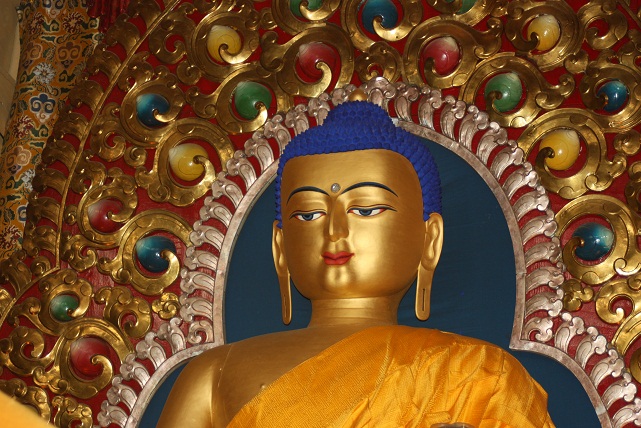
 The temple complex was full of life - monks and Tibetan pilgrims prostrated in prayer, or doing the ritual clockwise circuit of the temple, crowds of villagers queuing stoicly at a room where free eye-check-ups were being offered, tourists, both indian and foriegn, wandering around in curisoity and sometimes devotion. It was constructed in a short time frame when the Dalai Lama and his entourage first arrived, with fresh bright colours and large chunky pillars, and looks a little like a Buddhist version of the Georges Pompidou centre. There are significant statues inside: one of Avalokitesvara, the Bodhisatva of whom the current Dalai Lama, and the thirteen Dalai Lama's before him are said to be reincarnations, another of Buddha and a third of Padmasambhava, an Indian scholar who is credited with introducing Buddhism to Tibet in the 8'th century. Some pieces of statues were rescued from the destructive vandalistic acts of the chinese and smuggled across the Himalayas with refugees to be reconstructed here.        
  Two shaven headed Tibetan monks took a short break from their circuit to take photos of Fia and Tamsin, and we struck up a small conversation - we found out that the following day was a festival (democracy day) and there would be celebrations in the temple complex - the Dalai Lama was not expected, but may make a surprise appearance. Both of the monks had themselves escaped Tibet, braving the cold of the Himalayas to get into Nepal and then onwards into India.


2/9
The next day we were back to the temple for the festival.
 Fifty one years ago on this date, following a presentation of a programme for the governance of Tibet from the already exiled Dalai Lama to a large collection of Tibetan exiles, the first democratically elected body, the Commission of Tibetan People's Deputies, took office. It was largely symbolic given that the deputies were in exile, without any real facilities and the Chinese were firmly in control back home, but it was a significant break from tradition - Tibet having been ruled, effectively, by an "elitist" monk class up to the moment of the invasion.
 we had by now, allowed expectation and hope of seeing the Dalai Lama grow to excitement level, and we were set up for a probable disappointment. There were already crowds of Tibetans, a sea of maroon robes as well as many others. We found a spot near the front - to our left were the guarded iron gates outside the Dalai Lama's residence, with the unattractive tall windowed building beyond, in which every face that appeared momentarily became the Dalai Lama, in front of us was a cordoned off walkway to the front of the temple where a larger area was cordoned off to be used as a sort of stage.
  A police accompanied convoy of black ambassador cars with diplomatic flags arrived and were let into the residence, causing a flurry of excitement. Next to us was an English girl - she was in India only for the Dalai Lama.
 "I love him... I love everything he says...he is the ultimate wisdom for me", she said with full sincerity with eyes glazing over as words failed to help her express the extent of the love she felt. She had of course not missed the teachings as we had, but had also attended many others in different parts of the world following the Dalai Lamas visits. To the right of us was an English speaking girl from Singapore  - a buddhist, with excellent knowledge of Tibetan Buddhism and clearly experienced in the exiled Tibetan scene in Mcleod,
 "the security guards are not carrying guns - that means that the Dalai Lama is not coming...oh look.... that man is the Oracle - the Dalai Lamas chief advisor".
  The gates to the Dalai Lamas residence had swung open and a group of Tibetan dignitaries and a few VIP Indians marched out. It caused a flutter of expectation across the crowd, which died down when the realisation spread around that the Dalai Lama was not amongst them.
 It is hard not to be uplifted by the obvious reverence in which the Dalai Lama is held by Tibetans and visiting foreigners alike. Clearly his notoriety has come partly as a result of his significant position as the spiritual leader of the Gelugpa sect of Tibetan Buddhism, which is, in fact, only one of several sects, including some that are much older (such as Nyingma, followed at Kungri monastery where we had stayed in the Spiti valley), but was the sect that historically won the Tibetan royal patronage and gained ruling status in the country. He was found as a young boy, born to a poor rural family, by a party sent out after the death of the previous 13'th Dalai Lama to search for his re-incarnation. Various signs had guided them to him - the 13'th Dalai Lamas head had turned after death to a north-easterly direction, and the Regent had had various visions that gave them indications of the monastery and even the precise house where he resided. He had to pass the usual test for a reincarnated Lama, identifying the few objects that belonged to the previous Dalai Lama from among a wider collection. before he was taken from his family and entered, at the age of three years, a new life of intense education and attention, accompanied by the weighty expectations of millions.  
  The notoriety then went global when he became the face of occupied Tibet, presented along with images and accounts of the destruction and cultural vandalism that the Chinese reeked on Tibetan religious and social heritage, ransacking and demolishing temples and burning scriptures.
 But there is more than the position that the Dalai Lama was fated for, that is behind the adulation and inspiration that he has generated worldwide. We left Mcleod Ganj without seeing or hearing him, but we were in Dalai Lama land for 8 days, and his presence, grace, compassion and sagacity sunk into us like water into sponge - through people we met, through the Tibetan monks that we spoke to, through the temples, the posters, his quotations that appeared everywhere, and the historic portrayals in the museum, and we left disappointed, but feeling acquainted and closer than we had been when we arrived.  
 The festival was launched when the traditional Tibetan musicians paraded in, with an upbeat Scottish sounding tune together with marching drummers and bagpipes, decorated with a (surely conincidental?) tartan ribbon, dressed in immaculate traditional dress - the ladies in blue tunics with striped aprons, the men with grey skirts, yellow waitcoats, high leather boots and a tall fur-lined hat. The marching music was followed by singing - a harmonious chorus of mostly ladies, reminding us of the hauntingly beautiful music we had heard at the Ladarcha festival in Nako.
 As the music gave way to speeches, and then what seemed like prize giving for school essays, we took our leave - the girls leaving the letters they had written for the Dalai Lama with the security guard at the entrance to his residence.

We had to work for our lunch - we had headed down the steep hillside out of Mcleod Ganj on a long walk to find a restaurant that was highly recommended in our guidebook, only to have to climb our way back with empty stomachs having found it closed and no longer bearing any resemblance to a restaurant. We ended up back in Mcleod Ganj at the Tibetan Kitchen - soon to become our favourite Mcleod restaurant with their mouth-watering menu of Tibetan and other asian dishes at deceptively cheap prices.    
 We had planned a hike for the afternoon, and set off after lunch. From Mcleod a road led us into Bhagsu - a neighbouring, almost connected village with a temple (which somehow we missed) and a dubious public open-air swimming pool, fed it seems from a spring. It was bustling with activity and ringing with screams of laughter - but only Indian men and boys were swimming, mostly in their underpants. For women, it was presumably considered inappropriate, though they seemed to be sharing the joy of their male relations.
 On from Bhagsu village we followed the river up to the Bhagsu waterfalls. We were in beautiful nature, but far from being in isolation as the path was well frequented by mostly indian tourists trailing both up and down. One group of lads had clearly celebrated their efforts with a drink or two, and we were stuck for 20 minutes with them while they hugged us all, and insisted on photos of every possible permutation of their large group with each of us, until we had to literally prise ourselves free from their grasps and their pleas of "one last snap".

 We arrived there just as the rain started and as it became heavier, we took refuge in a stone tea-shack with a polythene lined roof. It poured so heavily, pierced by ear-splitting cracks of thunder, that we could hardly hear each other talk, and by the time we finally ventured out again, we had drunk so much chai that we were in danger of overdose, and meanwhile had become good friends with another Indian family marooned with us. We were entertained also by a man who had spent his afternoon there, but drinking beer rather than chai (seems to be a popular draw to the waterfalls), and was having difficulty to keep control of his limbs. Somehow, he insulted someone in the Indian family, a few shoves had been exchanged and he fell over a pile of crates of empty bottles, knocking them over and breaking all the bottles. He was sent off stumbling down the path in the wet. The girls were gripped with the whole episode and questions on the man, beer, fights and bad people continued to surface for the rest of the day.
 We followed a different track up and across the mountainside to get directly back to Dharamkot rather than returning through Bhagsu - this one was completely devoid of tourists, or anyone else, and we had to work from a general sense of direction to get us back to the Family Pizzeria, around 2 hours later.

4/9
 Mount Triund:
 Two days later we set off early in the morning, with light backpacks, to climb Mount Triund - the towering mountain that looks down over Dharamkot, Mcleod Ganj and Dharamsala. We had heard that there was a forest bungalow guest house on the top, and also the possibility to hire a tent as the guest house was often fully booked.
 We had woken to torrential rain. The weather forecast indicated that it was sunny now but would be raining for the rest of the week, so a 'wait and see' option didn't look very promising either. We had our umbrellas and waterproofs, so were prepared, but we accepted that it wouldn't be pleasant, particularly if we were camping. We stopped at Daramkot village for a breakfast, with vain hopes of the rain abating, but when it didn't, set off anyway, wrapped up in waterproofs.
  A dog that had been sitting outside the Himalaya tea shop at the end of the village, decided to join us, and walked with us for an hour, all the way to Gullu temple. The girls named him Banoffi because of his dark and beige colouring, loved his company and were a bit upset when he left us at the temple - though I was partly relieved as I wasn't looking forward to being part of a territorial battle when he arrived on the turf of another pack of dogs.
  Luckily the rain started to fade, and within an hour or so we were able to take off our waterproofs. It was a 5 hour (including our regular stops) highly rewarding walk , of continual and often steep ascent, from Daramkot at 2000m to the summit at 2900m. The girls needed a little pushing, but about half way up we caught up with a couple of friendly american ladies who had previously passed us while we were stopped for a drink at Gullu temple - the girls latched onto them, and the engaged conversation motivated them to walk without complaint. They now love meeting people, probably as a welcome break from the intense relentless company of their parents, and as time passes we can see their confidence growing and their conversational skills improving.
 We stopped at a small tea-shack, about half way up. Just after, a group of Indian lads, who had also been taking a break, moved onwards, the tea-shack owner suddenly launched into a passionate discourse about young Indians: they think they own the place....they think they have money but they don't..they'll have all their alcohol in a bag, and they'll be singing and making a noise tonight...they'll leave all their rubbish all over the place...... We were a little shocked at his outburst, but later that evening we passed the boys on the mountain top, and his assessment turned out accurate.
  It was a pretty exhausting 5 hour walk, and when we arrived at the top in beautiful warm sunshine we all collapsed onto a blanket-covered camp-bed that was outside Suresh's little tea shack, and rewarded ourselves with tea and noodles.
  It was breath-taking - we were in the Dhauladhar mountains, the foothills of the Himalayas - on one side of the ridge, jagged mountains led up to the heavens, and on the other, the plains extended like an ocean to the horizon, with clear views of Mcleod Ganj, Dharamsala and the dam in the distance.
  We asked at the forest bungalow, but as expected he was unable to offer us a room. It sounded very vague but it seemed as though reservations were taken at the office down in Dharamsala, but the first that the keeper would normally hear would be when the people arrived at the top. Today he had heard that a group of americans had reserved and were on their way up. We started checking other options. Tamsin and I hiked a further 25 muddy minutes along the ridge to another guest house. It was uninspiring concrete cells, basic and dirty and our renowned group of partying young indians, holding their plastic bags of whisky and beer, were also checking a room.
  When Tamsin and I  were back to Jacqui and Fia, the sun was getting low. We made another try for the forest bugalow, and eventually persuaded him that we would take a room, with the proviso that if the Americans turned up, we would have to move out and into a tent. The room was lovely - the outside was built in stone but from inside it felt like a wood cabin, with  - wooden boards making up both the floor and walls, and the windows looking down the mountain across to Mcleod Ganj and the plains. There was no bathroom, toilet or water - we were nature's guests tonight, and we loved it.
  We had a dinner of vegetables and chapati back at Suresh's tea shop, sitting on the camp bed that we had now made our own. The evening turned into a spectacular one - warm, with the setting sun pulling a jagged shadow up over the mountains like a pair of night socks. The clouds had grouped to lay a warming blanket over the plains below us, inviting us to step off our mountain and cross the cotton wool plateau to the horizon. We were all feeling special, on top of the mountain with such humbling views, and any worries about someone arriving to claim their room and turf us outside was fading, until suddenly we heard voices and watched a group of 3 American sounding tourists, together with a few indians climb up the path and head towards us. They were delighted to have made it after having accelerated to get up before the dark, but our reception was icy cold as we saw our lovely mountain hut slipping through our fingers. We posed the fatal question to which we were frightened to hear the answer:
  "where are you from?"
 "Israel" said the girl with a smile, at which we all let out a big sigh of relief.
  "ohhhh....how wonderful" we said to her surprise. We didn't explain that anything other than American would have sufficed, in case we tempted fate.
 The evenings conversation had been about black bears, who inhabit the mountain. They are known for their attacks on people  and we were told of a recent death at nearby Kareri Lake. It created a great deal of excitement when we came to the night time, torch-lit sortie to clean teeth and go to the toilet.

  We slept the night in our cosy wood cabin, four of us in a bed - top to tails.

5/9
 In the morning we were out of bed at 6:30, wanting to get out in time to see what was reportedly a stunning sun rise, but unfortunately in vain as the sun made its muted appearance through a veil of cloud. Nevertheless it gave us a good start to the day and Suresh prepared a breakfast for us of porridge, eggs and chapati, before we set off walking again up the hill towards Laka Got.
 By now we had discovered that Laka Got was not a lake as we had thought. There is a sacred lake up the mountain, but it was beyond Indrahar Pass, which was another 2 days trekkng away including a night sleeping in a cave. We were not equipped for the night in the cave so decided to go for the trek up to Laka Got (3300m) only, then return in the same day all the way back down to Daramkot.
  It was a stunning walk, wih the path picking its way up between crags, around headlands, amid giant boulders, grazing goats and surveyed by graceful eagles gliding effortlessly above our heads.
 A stone built shelter marked our arrival at Laka Got - the Snow Line cafe, although when we were there the snow line had fled up the mountain side infront of us towards the Indrahar Pass.
 "I been here sixteen years" said the keeper, sitting cross legged like a hermit when we peered inside the shelter, obviously no longer feeling the need for the usual terrestrial greetings.
  We stayed for a while - absorbing the beauty of this God's perch in glorious Himalayan scenery, and took sustenance of a dahl and rice and a packet of crisps.
  A friendly dog that had accompanied us all the way from Mount Triund was named Goggle by the girls, who became very attached to him. When we arrived at Laka Got, he too lay down and rested at our feet while we stayed there, then obediently stood up with us for the return trip.
  The return was downhill, the rain had stopped and the sun was shining, and it was a beautiful walk. The girls were skipping along now enthusiastically, in front of us, and Tamsin, in an unprecedented burst of appreciation, turned round to us and said
 "Mummy and Daddy..... thanks for taking us to India".
 Maybe the repeated comments to the girls from everyone we met about how lucky they were, were starting to soak in, or perhaps it was just the positive emotion that comes from going downhill after a steep arduous uphill, helped no doubt by the fact that for once, even if temporarily, they had Goggle, their own dog.    
 We descended back past Mount Triund and then took a different path down - a "short cut" that someone had mentioned to us that went directly down to the Family pizzeria where we had kept our room, rather than round via Daramkot village. It was a steep descent, past an impressive waterfall, and we were working a little bit from the bearings of the mountains, but not very confident about where we were going. We passed a couple of villagers on their way up who reassured us, and eventually arrived at some houses - we had been on the right path - although it had seemed much much steeper descent and no shorter than our path upwards. All of us were suffering for the next two days - feeling the tinges in our calves every time we went downhill.
We flopped into the pizzeria with enough energy left only for a weary game of cards and a pizza.

6/9 - 8/9
 Breakfast was at the Moonlight restaurant in Daramkot, using their wi-fi to do some work on the blog, while the girls were working on their diaries. We were there in the end until mid day, when we headed down to Mcleod Ganj.
 On our way down the path, which woun3ed through the middle of the forest, there was a large troupe of monkeys scavenging out of the bins, They were blocking our path like striking pickets, nonchalently fingering their findings clearly with no fear of us. Having heard from a few locals not to provoke them in any way, we were all a bit nervous to get past them and shuffled around looking for an alternative way down off the path. We found no alternatives and started trying to mutually summon up the courage to walk straight through the middle of them, but just at that moment, we spotted a group of locals on their way up, so we drew our confidence from them, and took the opportunity to pass the unperturbed monkeys at the same moment. Someone had told us, probably a little melodramatically, that even if you let your eyes meet theirs it can be interpreted as a sign of aggression - so we all walked through with our eyes firmly fixed to the ground.

The plan was to go to the Tibetan museum, but it was (yet again) festival time and there were a number of traders and fair stalls lined along the streets, which we coudn't resist. We ate at a colourful little shack, sitting amongst the Tibetan monks and other fair-goers on a makeshift bench in the street, then Fia and Tamsin played a few of the fairground type games  - throwing hoops onto objects and rolling table tennis balls down a board into slots - both of which lured their customers by prizes that looked like the sort of things left over at the end of the Nerville village brocante ("bring and buy" sale) - a dusty box of an unheard-of perfume, an out of date packet of sweets, a mini-teddy bear with a missing nose. The girls played for a while on a huge inflatable slide, then we headed into Mcleod for a coffee.
  We had put our names down as volunteers for English conversation class with the Tibetan monks and other Tibetan refugees, at the Lha centre - a non-profit establishment that works towards Tibetan refugee welfare, as well as supporting and promoting Tibetan culture and arts and crafts. We didn't quite know what to expect, but had envisaged that the four of us would together have a group of maybe 4 Tibetans, to whom we would chat.
  We arrived at Lha at 4pm to find the corridors crowded with Tibetans - monks and others - and having established that they were all waiting for the English conversation class, we joined the melee. The doors at the end of the corridoor opened, and the crowd shuffled in as one unit, everyone grabbing a cushion and finding a place on the floor. Not quite knowing what we were supposed to be doing, we hesitated a mere second before we were torn apart between different groups of monks that had formed, and seated down amongst them. There was no question of us staying together - the English speakers needed to be distributed evenly. Each of us had our own circle of about five Tibetans seated on the floor around us - we were'nt too confident of Fia and Tamsin's ability to facilitate conversation with a group of monks with little English, but in hindsight it was a great opportunity.  
  It was a fascinating experience, and a privilege to be able to converse with people with such different backgrounds than ourselves and who have been a living part of one of modern history's most significant events. Their openness, frankness and willingness to talk unlocked our curosity and our inhibitions and after a round of small talk, we let our increasingly daring and intimate questions fly out, as we listened gripped with their stories. How they became monks, how they came to India, whether they mixed with Indians, etc.
 Most of the Tibetan refugees esaped from Tibet themselves, all making treacherous journeys on foot over the Himalayas into Bhutan or Nepal, braving sub-zero temperatures, some with stories of others that perished on the route. Now a small but growing number of young refugees are second generation, born in Mcleod Ganj to parents that made the crossing. The first waves of refugees started in 1959, once news spread that the Dalai Lama had left. The Tibetans that stood to suffer most as part of the Chinese occupation were the ruling monk class, who were stripped of privileged positions, and persecuted in their worship, with many monasteries demolished and their contents redistributed to the people, or simply destroyed. Many faced intimidation to renounce their faith or to forsake their loyalty to the Dalai Lama, and several of the people we spoke to quoted this as the final trigger, forcing them to leave home, posessions and sometimes family behind, and embark on the hazardous route crossing Himalayan mountain passes over 5000m high, more worried about capture by chinese soldiers than perishing in the freezing temperatures. Also standing to lose were the landowners and other people of position, who had land taken from them and redistributed to neighbours, and those that had supported the Tibetan resistance fighters who were humiliated in front of their neighbours with their possessions handed out amongst the community.
 Not everyone was fleeing from religious persecution - one girl who had lived in a remote rural village that had remained untouched by the Chinese had left for Dharamsala in seach of economic opportunity - fleeing from a feudal system where women had little access to education and whose futures were fated as domestic workers in the house and in the fields, imprisoned by their society's restricted expectations. Her sister lived in Dharmasala, and had sent back reports of education and improved opportunities. Others, particularly non-monks, also mentioned the pull of India - housing, water, electricity, economic opportunity.    
 I was interested in what enticed monks to embark on such an austere life of simplicity and hardship, particularly as some monks can commit their lives at a young age where such levels of religious devotion are hard to imagine. One or two spoke of genuine spiritual motivation, normally from a particularly inspiring mentor, but others gave more arbitrary reasons. One spoke about how he had joined the monastery at a young age against his family's initial wishes - he admitted knowing very little about the religious aspects, but remembered thinking that they wore "cool" (his words) clothes and had a "great" life. The "sacrifice" of the monastic lifestyle was put into context for me - Tibetan life at that time, outside of Lhasa was mostly feudal, subsistence and nomadic agriculture.          
 The girls asked questions about the Dalai Lama - they were moved by his story and wanted to know whether he had remained in touch with his family when he was taken from them to Lhasa for his life of preparation for his significant leadership role, and whether they had come with him when he excaped from India.
  We came out of the classes, buzzing with excitement about the discussions. We went straight to the Tibetan kitchen, ordering a selection of exotic sounding and delicious Tibetan dishes -  Tam-yum soup, honey chilli vegetables, "specialty" roast chicken, fried baby corn, chicken momos - and in a flurry of vivacious conversation, shared our stories and learnings. We were delighted, with hindsight, that the girls had been on their own - they were bursting with pride and enthusiasm about their conversations and couldn't wait to recount it all.

The next day, we repeated the classes. The girls, knowing this time that they would be on their own, prepared more questions, and we had visited the Tibetan museum in the morning which had also raised both our understanding and a host of further questions. We were all greatly moved by the museum - images of the ransacked social and religious heritage of Tibet, footage of the chinese brutalities in suppressing demonstrations, harrowing accounts of the treatment of political prisoners. We were shown a film - a US documentary on Tibet, the Chinese occupation, and the embarrasingly muted world reaction to it at the time, hampered by conflicting interests that prevented the ruffling of Chinese feathers.    
 I was fascinated to learn more about the other side of the story in my conversation with the refugees. Tibet was a backward country at the time of the occupation - a harsh feudal system, with many injustices. Tibetans as well as Chinese participated in the rejoicing at the arrival of the chinese, and many of those in underpriviledged positions stood to gain. I asked about the chinese occupation - had they had direct experience, what were their memories, did any Tibetans see it as a positive historical event. They were all so open and honest, that it was a unique and direct opportunity to learn. I was of course asking almost impossible questions to a biased sample - I was talking to monks, who had faced direct persecution and who had clung to their faith while it was being torn from them, denied and spat on. Nevertheless, they were able to dig behind their provoked emotions to find objectivity  - yes, Tibet had gained economically as a result of the advent of the Chinese, most peoples lives had improved materially, inequity and grievances had been exposed and some social injustices rebalanced - though most (but not all) denied that any Tibetans saw the occupation as a positive event. The loss of soveriegnty, the loss of political freedom and the painful destruction of their heritage as part of the cultural revolution could not be compensated for.    
 One of my "students" was in Lhasa at 10 years old and recounted a vivid memory of a group of monks waving the Tibetan flag and shouting to the chinese to leave - the boy watched as one was dragged by the feet by two soldiers, and a van full of reinforcements of chinese soldiers arrived - the monks were thrown in to the lorry. Another monk recounted how his remote monastery was able to continue unaffected by the Chinese, until the monastery leadership visited and stayed for two years with the Dalai Lama in Dharamsala. On their return, the monastery started to receive visits and attention, with individual interviews putting monks under pressure to renounce loyalties to the Dalai Lama.  
 Despite the fact that many Chinese have been encouraged to settle within Tibet, and have taken leading roles in commercial activity, leaving some of the indigenous Tibetans alienated outside a growing and changing economy, all of the refugees that we spoke to refused to show any resentment for the Chinese people (who in fact are sometimes innocently ignorant of the damage that has been inflicted on the Tibetan social fabric), and focus their bitterness on the Chinese government. We saw a similarly remarkable tolerance and conciliation in statements that the Dalai Lama has made with reference to the Chinese, and wondered if it had spread from him, or whether both were part of an inate Tibetan nature.        
 After the conversation classes, when we regrouped as a family, we were all dying to know why Tamsin's group of refugees had gathered in a tight circle around her at the beginning of the class. She explained. They had asked her what she had been doing that day. She had told them that Fia and herself had been singing a song under an umbrella in the pouring rain, as we had walked down the hill from Daramkot that morning. She refused their insistent pleas for her to sing the song, until they offered a solution so that no-one else in the room could hear. So they closed around her in a seated circle, arms linked, and Tamsin gave a solo rendition of "Champs Elysee".
 As our rickshaw hobbled its way back up the steep pot-holed hill to Daramkot, with the make-shift polythene curtains closing the sides, barely able to keep out the incessant lashing rain, we felt light from our touching memorable experience with the Tibetan monks - stimulated, enlightened and warmed by their sincerity, strength, kind heartedness and sense of humour.

Meditation and yoga
 Fed by the presence of spiritually sensitised visitors, Mcleod Ganj has become a thriving centre for Tibetan and Indian meditation and yoga classes.
 We decided to give it a go, and were up early one morning, dressed in the stretchiest clothese we could muster, trekking along the Daramkot overgrown mountain paths to get to "The Sanctuary", a meditation and Yoga centre. We were fielding incessant questions from Fia and Tamsin who were desperately trying to understand what exactly you did in an "assisted meditation" class.
 "But you just sit there doing nothing for a whole hour. Why?"
 "Why do you need someone to help you to do nothing?"    
  Being in the dark almost as much as them, we gave up and decided to leave the experience to tell its own story.

 We were welcomed before we entered, and told to remove our shoes, and that once we entered through the doors of the centre, we were to maintain complete silence. We timidly walked past floating candles into a large room, soothingly decorated with purples and maroons, where two ladies were already seated on cushions waiting for the class. We exchanged limited nods as tokens of polite greetings, nervous not to break our vows of silence, and each fetched our own cushions and found a space.
 In a short while our teacher arrived and took his place cross legged at the front, using a microphone to welcome us in his deep, slow, chocolatey voice, and start to guide us through the steps.
  We were to start by letting go - and to let go, we needed to lie down, tighten all our muscles, scrunch up, and let out loud groans as our muscles released the extremes of their tension. We all lay down, tightened our muscles, scrunched up, and let out barely audible sighs. This was not good enough. He demonstrated, writhing like a snake and culminating in a long, room-reverberating roar. We sheepishly tried again, and ended with marginally less inaudible moans. It seemed that this would have to do and we moved on.
 Our eyes closed, we were to sit cross legged in a comfortable position. We waited in position.
 Chocolate voice: "If anyone does not feel comfortable in this position, then they can lie down"
 We waited.
 Chocolate voice: "If you don't feel comfortable, then feel free to lie down".
 We waited.
 Chocolate voice "If you are not comfortable, then it is better to lie down".
 Sensing something amiss, I ventured a badly disguised peep out of one eye - he was looking directly at me, and gave me a knowing nod as he repeated his command, never slipping from his resonant hypnotic tones. I got the message, untangled the knot in my legs and lay down - clearly my body's resemblance to a plank of wood had already been spotted.
 He guided our untrained minds through the steps. We were to make ourselves conscious of the noises around - the rickshaw engine strugling up the Daramkot hill, the dog barking, voices in the distance. Breathing was critical - deep, slow, rythmic. Bit by bit, we were to turn our focus from the outside world to the interior - our breath, our muscles, the weight of our legs, our posture. Every muscle was to let go.
 "Let ...your....beeellyy...looooose.."
  It was working, I was drifting, but then... I would think of Fia or Tamsin sitting there, trying to control their young distracted minds, and work out how to let their bellies loose and a smile would involuntarily creep onto my face, as the nirvana moment would slip through my fingers.    
  It was an experience, and we enjoyed it, but the only state that we had managed to transform ourselves to was hunger, for the muesli and eggs breakfast at the Moonlight restaurant across the road, where we read a downloaded copy of the Herald Tribune and heard how ex-world leaders, Chirac and Mubarak were both reportedly too ill to face the corruption charges levied against them.

 Later, after our English language classes with the Tibetan monks, we went up onto the roof of the Lha centre for a lesson in Tibetan yoga. It was an incredible setting - bathed in a warm setting sun, with many exercises leaving us staring up into a deep blue sky, where eagles glided in high circles. The friendly Tibetan Yoga teacher took us through chains of exercises, some of which I thought were more suited to a rag doll than a human, though the rest of the class fared better than me, including both Jacqui and our two flexible little daughters. I disgraced myself further in the breathing exercise - we were to hold one of our nostrils closed with a finger while breathing deeply through the other. I lapsed and glanced across at Tamsin on my left to see how she was faring. I couldn't help breaking into a giggle, channeled loudly through my one nostril.

Friday, 2 December 2011

HAPPY BIRTHDAY FIA


HAPPY BIRTHDAY FIA!!!
This is Fia's entry in her diary (publishing with her permission) on her 10th Birthday - November 22. We were in Mysore in the state of Karnataka.
I've translated it into English as she is writing her diary in French.


Today is my birthday. I really am 10 years old. Tamsin gave me a hairclip with a lovely blue flower full of glitter in the middle. I put it on immediately. The same for my T-shirt which had 'being human' written on it and also a minisculebindi (editor: the red spot that hindus wear in the middle of their foreheads).
 I also got some pale pink nail varnish. We ate a continental (editor: cornflakes, eggs and toast rather than veg curry and rice!)    breakfast with Yaya and Bappo (editor: grandparents) and they gave some sweeties and a little card game to us and a packet of lovely knickers to me (which I quickly hid under the table!). After, we saw the beautiful palace of Mysore. We saw 800kg of gold! Then we went to see TinTin at the cinema (it was very funny). In short, I had a very enjoyable day. Later we put on our lovely indian outfits and a necklace of flowers and went out to dinner. All six of us had some yummy chocolate cake with 10 candles on it. There was a flower made of icing on it - there was also written HAPPY BIRTHDAY SIA - which they changed for FIA!

Sunday, 27 November 2011

Sarahan and Rampur

26 August
Jacqui woke up ill with stomach cramps and clearly had a bug. We agreed that even if it was painful we would need to make the dash for Sarahan, where she could rest in peace, rather than in the flea-bitten noisy fumey rubbish dump that we were sleeping in, in Jeori.
 She sat, morose with head down, on a bench, while we waited in the heat for a bus, then flopped into a seat, focussing hard on survival until the destination. It was a thankfully short ordeal, and she survived the journey - mostly asleep, as was Tamsin from the effects of the travel sickness pills, while Fia spent most of the journey fascinated by a giant locust that had found himself in the bus with us. We left Jacqui in a heap of our rucksacks at the side of the road in Sarahan, whilst the three of us raced around town looking at the accomodation options. The choice was easy - we found a wonderful room inside the Hindu temple.

 Large, with a bathroom and a secondary annexe room where the girls would sleep on mattresses, and with an austere feel to it but spotlessly clean, and the key factor being that we were inside the temple - stepping out of our door onto a balcony adorned with sculpted wood, and overlooking the courtyard of the temple complex.
 Jacqui slumped lifelessly onto the bed, and we decided we would stay at least 2 nights, and long enough for Jacqui to recover.
 Fia, Tamsin and I went for an exploratory walk around the village. The renowned Bhimakali temple in which we were staying, dominated and formed the central heart, hemmed by a few streets lined with rudimentary stores and eateries, and with a backdrop of the green hills on one side and the view down the valley on the other. We stopped at a very basic restaurant and ate momos and rice, followed by an ice cream, before we headed back to the temple and launched into a maths lesson, and diary writing, sitting at the convenient table in our room.
  Jacqui summoned her energy to join us for dinner at a fairly sad restaurant, but after two spoons of tomato soup she regretted the decision, and headed back to the room to be horizontal and close to the bathroom.
 It was wonderful to be in the ascetic midst of this sacred site, but we all missed Jacqui and it made for a subdued day.

27 August
 At around 4-5 in the morning (we can't remember exactly) the recorded music, piped out of a loadspeaker from one of the temple towers, started. A singer accompanied by a band churned out non-stop, presumably religious, songs. It reverberated around our room such that it seemed that they were there with us - the musicians with their sitar, flutes and drums at the end of our bed, and the moustachioed singer in his loose fitting shirt and large beaded necklace, enthusiastically delivering his musical sermon directly at us, one foot up on our bed. I was impressed to see Jacqui getting out of bed at one point to join the worship, but in fact she was just going to close the window, muttering some words that were probably inappropriate for our environment, and then adopted a posture of worship that was unfamiliar to me - lying with her face down and a pillow over her head.
  Jacqui showed some improvement and had some first traces of hunger. She wanted however nothing but toast, and having curiously been told the previous night that toast was "out of season", we headed for the the one smartish hotel of the village. The waiter must have been slightly bemused when we delivered our all important question to him "do you have toast?", before even setting foot through the door, with all four of us waiting anxiously for his reply as if it was life and death, and sighing in satisfied relief when he answered positively, before we all piled in and ordered an enormous breakfast of fruit, cornflakes, eggs, and mountains of toast.

 We had laundry to do, and for only the second time, could not find someone willing to do it for us. I managed to enthuse the girls about the task, and using a bucket in the bathroom and a bar of soap they set about the messy, wet and fun business. When all was washed, in an approximate sort of way, it came to finding somewhere to hang them out. Being in a building of religious sensitivity, I went to ask the temple keeper, who told me I could use the railings around the temple courtyard. I looked around me at this 600 year old sacrosanct establishment, with its trail of pilgrims and worshippers filing through to cleanse their souls, and admit feeling a little uneasy about his proposal. Nevertheless, I rallied the girls who duly jointly carried the heavy bucket of wet clothes and started hanging them over the railings around the courtyard. A little while later they brought the bucket to me with some clothes still in the bottom.
 "What's this?" I said.
 "We are NOT hanging out knickers.....it's EMBARRASSING" said Tamsin, the union spokesperson.
  Sensing a solidarity resistance starting to build, I knew I had to be firm and act quickly to stamp it out.
 "Don't be ridiculous! Everyone wears underwear. Just get on with it". It worked and the girls reluctantly shuffled back to the railings with the bucket, while I quickly sidled off inside, on the pretext of checking how Mummy was.
 And so it was that the worshippers at the revered BhimaKali temple, who rang the bell to summon the gods on their entry, removed their shoes and diligently washed their hands and feet before kneeling before the steps, clasping hands together then bowing to kiss the ground, were, on this day, likely to be distracted by the gentle flapping in the breeze of Jacqui's knickers in the corner of their eyes.            
 Jacqui was able to summon enough energy by the afternoon to join us on the visit inside the Temple. It had stricter rules than any other we had seen - all having to wear head scarves, and remove any leather articles or clothing. The temple has two main and historic towers - one, which we could enter, containing a consecration to Kali on the higher floor, covered with a silver canopy. We paid our respects and were acknowledged and blessed by the attendant, who administered the small handful of puffed rice pieces, some holy water and using his thumb, stamped a bright red bindi on our foreheads.
 Legend has it that the rulers at the time of the princely states were descendants of Pradyuman (incarnation of cupid and son of Lord Krishna), who suceeded King Banasur when he had his head chopped off and buried at the front gate in a battle against Lord Krishna. The temple was bult by these descendents and dedicated to mothergoddess Bhimakali (a local version of Kali). Below the consecration of Bhimakali is one of Parvati, the consort of Shiva, and in fact the mother of Ganesh, the unfortunate elephant headed God.    
  To the side is the very old looking (before Christ according to some unreliable looking sources) Sikhara temple dedicated to Lord Narsingh,where human sacrifices were made up until 18'th century, and theoreticaly the practice still continues today with animals, or at least every couple of hundred years, with the last being in 1904 when 600 goats were given in an 11 day festival.

 Jacqui retired back to bed after her fragile exertion, while the girls and myself went walking around the surrounding hills  where we had lovely views of the temple from up above. We came across a man and two older ladies carrying baskets of apples that they had collected from the orchards further up and they offered us some. We gladly accepted and then unintentionally found ourselves walking alongside them back towards Sarahan and we started to make the simplest of conversation.
 The large baskets were strapped onto their backs and I was intrigued to know how heavy they were, so when they stopped for a break I offered to carry one. They all giggled, but I went ahead and walked a while with it until the old lady, who clearly felt uncomfortable with me carrying her load, either because she felt it was her work, or because she thought I would run away with it, took it back.        

28 August
  I was waking earlier in the morning than the other three and inspired by our spiritually cleansing environment, as well as a large floor space in our room, had taken to doing some Pilates exercises in the morning before the others woke up. This morning, the inspiration spread, and first Jacqui, followed by Fia and Tamsin enacted a series of Yoga exercises in the form of the five Tibetan rights that Jacqui had learnt once from an Indian guru while we lived in Dubai. It all started well, but the concentration and the poses were not to last and it ended up in a heap of legs and laughter.
  We breakfasted again at the HPTDC hotel (a state run hotel, we found out), counting on our supply of toast and eggs, but the waiter, by now getting to know us, cunningly waited until we were all seated and settled before he delivered the shattering news - they had no toast. We knew we had nowhere else to go, and that if this hotel was out of toast, then there was no toast available in the Sarahan district. It was a heavy blow, but we had to accept that we may have been partially responsible after our excessive consumption the previous morning, and we switched our order to chapatis.
 Jacqui was on her way to recovery, and joined us for a thali lunch before taking the girls for a french lesson for the afternoon.
  That evening, as with every other evening we had stayed there, Sarahan had provided a side show, that from our temple guest room, with views both into and out of the temple complex, we had excellent seats. There was a community of stray dogs, who cruised the town, normally in one large group. They were not at all aggressive to people, but often when they wandered inside the temple, the temple keeper chased them out by throwing sticks, to a cacophany of great yelping and whining. Any outsider to the community that appeared, even in the distance, provoked a territorial defence bark from the first dog to see him, which immediately sparked a community barking session from all the others, wherever they were - most without any idea what they were barking at. It could last for ages and they considered it a 24 hour duty.
  But territorial defence was only the supporting act - the main show was copulation. This was not just a two dog show - the build-up involved a group of frenzied males, moving in herd formation, sniffing wildly and shunting each other to get to the front, where a female would be sauntering along, head held high as if she were the only dog in town, and apparently oblivious to this testosterone turmoil scrummaging along in her wake. Of course, only one male would get past the auditions and play the main role in the final act alongside the female star - but the rest of the cast was not discouraged and would hang around  at different distances watching intently, daring an occasional sniff, patrolling for foreign dogs, as the two key players would stand motionless, locked back to back, tongues hanging out and grinning inanely.
  Tamsin and Fia watched the whole show whenever they could, both leaping up from a maths lesson whenever they heard the give-away barks or whining down below, as if it was the end of school bell.

29 August
Jacqui was better, and it was time to leave Sarahan and our wonderful temple home. As if the temple itself wanted to say goodbye to us, we woke to find a barely dressed sinewy Sadhu, with a knotted grey beard and ash-darkened skin hanging loosely off fragile bones, sitting cross-legged in front of a fire, chanting together with two other swamis and throwing seeds or other bits of food onto the fire. Sadhus have renounced everything in life - materials and family - and have dedicated themselves to the pursuit of worship. We stared at this quintessentially indian scene of spirituality before we were able to drag ourselves away and move on.
 We were heading to Mandi, as a stopover on our way to Dharamsala. We caught a bus to Rampur from Sarahan, nearly losing Jacqui on the the way when she took the opportunity of an extended bus stop to descend, but took so long hunting around the backs of buildings for a suitable place to go to the toilet, that Fia, Tamsin and I had to hold the driver from leaving, while 38 faces on the bus scanned in all directions looking for signs of her.
 The bus arrived at the bus station in Rampur at 12:30pm, but we discovered the next bus to Mandi was not until 4:30 pm, and also learnt (admittedly a little late) that the journey to Mandi would take 8 - 10 hours, meaning that we would be arriving and searching for somewhere to stay in the middle of the night.
 We decided to stay in Rampur the night - feeling a little ashamed of ourselves for failing to get to Rampur in time for an earlier bus, after having lingered and dawdled in the morning.

 We caught a local bus back up into the centre of this bustling, noisy town, and started hunting for guest houses. Rampur is of course not a tourist location (most tourists managing to avoid it by demonstrating a little more forward thinking and travel discipline than we were capable of), and we covered half of the main street of Rampur without seeing any sign of a guest house.

Fia then noticed a smiling security guard beckoning over to us. This was not an uncommon friendly gesture as many indians were curious and keen to help us, but we jumped on this one as we hoped he might be able to guide us in the right direction to find somewhere to stay. We asked about a guest house, but he had no English and pointed us towards his colleague sitting behind a table in a side room.
  "Hello, do you know where we can find a guest house?" we asked.
  "Shared bathroom" he said and pulled a key out of the drawer. We were a little confused until we realised that we must actually be in a guest house - there had been no sign on the door, and there was little other indication, but we followed him to the room. The place had an institutional feel to it, and there was a fairly unappealing shared bathroom with its row of dire cubicled "hole in the ground" toilets, but the room was spacious,  and he eventually agreed to bend the rules to give us an extra mattress for the girls, so we took it.
  We were by now hungry and we asked our new friend for a recommendation on somewhere to eat. He suggested the "canteen" just across the road.
  "Are there any other options?" we asked. "no..no.. no others" he replied, thoughtfully. We laughed a little to ourselves at the impossibility of Rampur having only one restaurant but anyway followed his directions up an outdoors concrete staircase, onto a rooftop where we squeezed into a tiny makeshift room, along with a handful of others crowded onto the only 3 tables, and ate our dahl and rice, the only choice available. What it lacked in choice it made up for in quality, and we ate as much as we could for 70 rupees (1 €) for us all.
  On our way back to the room seeing for the first time our "guest house" from the outside, everything became clear. Above the main entrance door, just to the left of the door through we had entered, was a red cross and underneath it was a sign saying "Rampur Geriatric hospital". We were staying in a room, completely unknowingly, in a geriatric hospital.

 We all took a little time to relax and read, but the e-books dropped and eyes submitted to the inevitable as Jacqui, Fia and Tamsin each in turn slipped into a travel weary siesta. I left them sleeping and went to explore the town which was much bigger than the one main road we had scouted, with a market coating the hillside down to the river at the bottom. It was an eruption of commercial activity compared to the sleepy villages that we had become accustomed to. Rather than a handful of outlets selling nothing more than the bare necessities, the Rampur bazaar streets offered everything - frying pans to flowers, creosote to coffins - and shelves were no longer garnished with a lonely 'out of date' and dusty packet, but were full to overflowing and bursting with variety. Temples or Hindu shrines were around every corner - now it was Budhism's turn to take the back seat.
  Later we all went for a stroll, checking information about the bus, ambling around the outside of the flamboyant timber and stone Padam Palace, built in 1925 for the then Maharaja, and taking a milky chai at the deserted Sutluj view hotel. We walked through the bazaar down to the river and a small temple beside it, where Fia and Tamsin took off ther shoes and entered to chat to a cross-legged resident sadhu, before working our way back up, collecting some fruit on the way for an early get away in the morning.


Locust, grasshopper - whatever, it was big!

Sarahan and Rampur photo album
Click here.


Wednesday, 16 November 2011

Kalpa

Photo album Kalpa
https://picasaweb.google.com/116253494913081133936/Kalpa?authkey=Gv1sRgCJPj3eycie31jAE#5675528271959656754

24 August


We had different reports about the time that the bus would be passing through Nako, the earliest of which was 7:30 in the morning, so we ate our breakfast with our rucksacks packed next to us, keeping an eye on the road in case we saw the bus coming in the distance. We were heading for Kalpa - a small village off the main valley road - so we would have to get the bus to Rekong Peo (around 5,5 hours) and then another up the hill for half an hour. This was the bus journey from hell. We thought we may have been numbed by now to the dramatic winding roads carved into the side of the mountains, with vertical drops down to waiting angry rivers - but these took the drama to their extreme, and worse still, this time we were in the hands of a different driver, who managed to turn this into a real life roller coaster. We saw him as a bus driver - he saw himself as something different - something much more competitive, more heroic,..more hollywood. He was Indiana Jones, Sebastien Vettel...Freddy Krueger. As we kept a grip with both hands to keep ourselves on our seats, Jacqui and I glanced at the river 300m below us, and gave worried looks to each other, wondering how and if we would surive 5,5 hours of this frightening ordeal, and several times Jacqui mouthed the words 'he's going too fast' to me across the bus, with a face that said it all. Our anger built for this faceless figure sitting behind the steering wheel, upon whom our family's lives depended. From behind, his trilby hat, and the dark hair falling below it, left my imagination to paint a picture of the contorted sadistic face on the other side. But from the occasional angled views that I had of his face, when he opened his window and turned to empty his mouth of the paan-chewing induced spittal, I saw his face was not scarred and bloodied as I had imagined, though I fancied that I could detect the little sadistic smile as he smelt the fear of his passengers while toying with their lives. Despite being drugged on travel sickness tablets, Tamsin felt sick within the first 10 minutes, moved to a window, and recovered later, but several of our co-passengers were not so lucky. It was a truly frightening journey where forced rational reasoning ("He drives this route everyday", "the other passengers don't look frightened"), was unable to hold back recurrent thoughts about the worst that could happen. Every approaching twist in the road, it seemed as though our full length bus, with its bald tires could not possibly hold onto the road at the speed we were travelling - but hold on it did, precipitous turn by precipitous turn, over five and a half hours nightmare of painful white-knuckled clinging.

When we arrived at Rekong Peo, it was with a great sense of relief tinged with sickness that we felt firm ground under our feet. I unloaded our rucksacks from the roof of the bus, and as I descended, the driver passed by on his way to a chai-break - I felt like telling him to take his reckless driving and his bus and stuff it up his chapati, but the relief of having arrived overtook me, and it was a weak smile that came out. Rekong Peo was shockingly big and bustling for us after our weeks of peaceful Spitian budhist villages and despite seeing a public communal dining event, with rows of people seated on the ground in a large park, clearly as part of some sort of festival, we stayed in the bus stand, with our focus remaining on our more subdued destination, one more short bus ride away up into the the hills.

Kalpa, when we arrived an hour later, was reassuringly calm. It was more or less built around one street and had beautiful views of the snow capped Kinear Kailash, a range of mountains over 6000m of altitude, sitting on the border with Tibet. We made a little trek around before finding a room at great value - clean, large and with a view to die for.


Even sitting on the toilet, you could see Kinear Kailash through a small window - so close that you felt you could touch it. This particular mountain is amongst the most well known in India from its revered significance in both hindu and buddhist faiths. Shiva (one of the 3 Hindu gods of which all the other gods are representations) lived on this mountain, and time and time again we came across references to it in different mythological accounts represented in temples and sculptures, and we were able to make the connection: "that was the mountain that we could see from our toilet".
We had a very traditional bite to eat in a little shack and then wondered to the Buddhist Gompa - interesting, though our appreciation was in ignorance as we found very little information about it. As we had moved west and left the Spiti valley to enter into the Kinnaur district, we seemed to be in a religious transition zone - Buddhism was present but no longer the dominant tone, conceding first place to the more prevalent Hinduism. The small village of Kalpa, which has a particular mythological significance for Hindus as it is said to be the winter home of Shiva, attracts masses of visitors during the Durga puja festival (in October in 2011, which coincides with the harvest season for the renowned Kinnaur apple) and the Phulech festival, crowding out the handful of guest houses, which then remain fairly empty for the rest of the year. We were clearly in a quiet patch, eating in empty restaurants and with no apparent company in our guest house.


25 August
We had a leisurely start to the day, with our barely opened eyes greeted by the glorious sight of Kinnear Kailash, carpeted with invitingly crystal-white virgin snow, itself enriched by the depth of the blue sky behind. Breakfast was at the Blue Lotus guest house next door - it looked closed before they turned the lights on at our arrival and everyone stumbled into their roles, but we never saw another guest there. We wondered through the village down to the Naryan Nagini temple complex (presumably where legend would have it that Shiva stayed during winter). It was an impressive complex with multiple temples dripping with elaborate wood carvings, and set on split levels down the hillside, but again, we struggled to find any information on the temple, and saw no-one else on our visit to whom we could consult. The village itself showed great historic character - houses, dilapidated but very much still in use for human or bovine habitation, were built from stone and timber, with large wooden balconies, in an alpine-like style and with elaborate but minimally maintained carvings in the wood panels. After lunch we waited for the bus that was due to arrive at 2:30 that would take us directly to Jeory, in time for us to get an onward bus to our next stopping point, Sarahan. But the direct bus never came, and we ended up on a bus at 3:15, taking us only to Rekong Peo where we waited, helped by a chai and chocolate bar, before we could get a bus to Jeory.


The girls climbed on to fight succesfully for two precious window seats, where we would get the vital air-flow, while I lugged the rucksacks onto the roof. The journey was just about bearable compared to the previous one, although the driver seemed to get progressively manic as time wore on since his last break, building up to a peak of speed just before we would stop and he would have a presumably calming cup of chai. Then we would start off gently again until the effects of his chai wore off a further time. The girls both went into a deep sleep - one of the side effects of the travel sickness tablets that are now becoming part of their regular diet on this stretch of our trip - and so the 3,5 hour journey passed quickly for them. This was our first experience of driving the mountain roads in the dark of night - worse if you think about it, but better if you don't as you're not visually exposed to the frightening sights of the precipitous roadside drops. Asking on the bus we realised we would arrive too late (8:30pm) for a bus up to Sarahan where we wanted to stay, so we resigned ourselves to a night in Jeori.

We knew nothing of Jeori before arriving, but it turned out to be a classic roadside town - activity centred around a widened area of the street, where buses manoevured, trucks belched large puffs of black smoke, loud horns were constantly blown, and bleary-eyed travellers stepped off buses to take the opportunity to have a bite to eat before continuing their 25 hour journeys through the night. The streets were dirty, and strewn with rubbish. We were down to below 2000m, so the air was thicker and sticky, and the lingering odours from heavy vehicles, decaying rubbish and urine mingled with those of the fried food from the eating houses feeding the constant passing traffic. For the first time in 4 weeks, you could feel mosquitos in the air.
We unloaded and walked into the first hotel we saw - it had a large busy restaurant, with whirring ceiling fans and crammed with weary travellers rushing their rice and dahl. Jacqui and Tamsin sat in the restaurant with the bags while Fia and I were led outside the hotel, down a concrete staircase with no sides to it, and under which was clearly used as a local dumping ground, into virtual darkness at the bottom, where the padlocked, bolted door was opened to reveal our room. It was a large dismal concrete cell.


The walls and ceilings had peeling, almost historic looking paint, were stained with damp patches and dotted with the remnants of squashed insects. The bed mattress gave away no indications of its original colour and was on the point of decay, and there was a couch in the room that resembled one you might see on a rubbish dump, with tears, worn patches, stains and ingrained dust. The toilet was of course indian style - thankfully - clean western sit-on toilets are an indulgent luxury, but dirty ones are worse than indian toilets where you avoid any contact. There was water seeping from undetermined places across the floor, and a persistent smell which pervaded into the room despite our efforts at keeping the door closed. There was a grill along the wall under the ceiling, ventilating us with the ground level fumes of the street ouside. The room cost 350Rs (5,30 euros) and he refused to move on the price, so I entered my usual routine of announcing that we would take a look around and would maybe come back.
"No udder otels", he told me straight - I walked out anyway, but was back 3 minutes later having regrettably confirmed his condemning statement with a few others, and we reluctantly hauled our bags down into the room, returning immediately to the restaurant to console ourselves.
We were indeed morally revived with what turned out to be a very tasty meal served with a restoratory beer, and a waiter, who was delighted to be serving visitors of such rare prominence, and then over the moon to be given a 10 Rps (0,15 euros) rupees tip.