Photo Albums:
1 http://youtu.be/i2Qi1mo6mvY
2 http://youtu.be/hfvmCWr31B4
3 http://youtu.be/Kp-5LNHeCXw
4 http://youtu.be/q8G-ROeo8Lo
17/9
Arriving very early morning on our night train from Jaipur to Udaipur in southern Rajasthan, we zig-zagged
 down a barely-awake narrow street which wound its attractive way down to the lakeside, to find the best hotel option and negotiate the best price.
We were delighted with a spacious and nicely decorated room at Hotel Udai Niwas, with a big double bed in the middle and arched cavities in the wall, lined with fitted cushions - the perfect little sleeping nests for Fia and Tamsin.
We had breakfast in the rooftop restaurant, rewarded with our first view of Lake Pichola, with the gleaming white fairy-tale Lake Palace standing in the middle as if it was floating, and the surrounding hills reflected in glassy waters which twinkled with the early morning sun-light. Udaipur must be India's prettiest city.
With a shortened sleeping night on the train, we retired to bed and then slept until 2:00 before we went out to explore.
Down by the lake, we stumbled on an informal looking street show. Men were sitting cross legged, or squatting in the centre while the actors were performing around them in a circle, stamping and shaking their bare-feet with jangling bells around their ankles.
 The costumes were an explosion of colour, ranging from Rajasthan traditional to fancy-dress-ridiculous with all manners of head-ware, heavy jewellery and face-paint. With some men dressed as women, the actors put on a performance which looked almost farcical with dancing, mock-fighting and "Punch and Judy" chasing around the circle, though the aggressor beat the victim with a stick rather than the proverbial string of sausages. It was only two days later, when we saw a similar performance in a rural village that we learnt a little more. These performers were Bhils - one of the tribes thought of as "Adivasi" (indigenous to India, as opposed to the Indo-Aryan or Dravidian historic immigrants). Traditionally hunters, they were renowned for their ferocity, and became valued warriors serving Rajput armies. In the Udaipur region they fought in the Mewar (the local ruling Rajput family) army, and became a thorn in the side of the invading Moguls by their skill in guerilla warfare, luring the enemy into a valley before enclosing and slaughtering them. Now formalised as a caste, Bhil men are still recognisable by their bare feet and their ear-rings on both ears.

Their warrior days were over when the warring between Maharajas and Moguls faded, and they have settled with a life of herding and occasional hunting, mostly at night-time because it's illegal. It seems they never stray from the poverty line. Women are traditionally highly protected, which explains why men take the women's roles in the acting spectacles that they perform as they tour nearby villages, and contrary to the usual Indian custom, it is the women that command a dowry in the arranaged marriages - the going rate being 10 goats (70 euros worth).
We had a late lunch at the nearby Minerva hotel - lured in vain by a satellite TV that we thought had a chance of showing the Rugby world cup - Australia were playing Ireland. Agonisingly, no-one seemed to know about rugby in India - and in the time we stayed in Udaipur, we had several bemused hotel staff switching through channels to find some sign of it before someone managed to put our hope to the grave by confirming that the only channel showing it was not available in Udaipur. We resigned ourselves to seeing the match reports for the time being.

Dinner was on the balmy rooftop of one of the many beautiful havelli guest houses, once homes of rajput nobles. Drinking beer out of a teapot, a common disguise used in Udaipur by unlicensed restaurants, we watched "Octupussy" on an antique television. The enchanting billionairess, Octupussy, lived in a palatial mansion on a women-only island in the middle of a lake. Udaipur's Lake Palace was used for many scenes, and the film is celebrated proudly across town, with every guest house adding "Octupussy shown" to their list of selling points advertised at their entrance. Two spaghettis mysteriously appeared on our bill without us having ordered any, and when I questioned it, I was summoned for the second time into the kitchen, where the manager surreptitiously explained to me that they also, were a cover-up for the beer.
18/9
A torrential downpour drove us from the rooftop of our guest-house where we were eating breakfast. With no sign of stopping, we postponed other plans in favour of a french lesson.
Later we managed to make the long walk, past dusty antique shops selling giant stone elephants and statues, to the tourist office, stopping for an excellent lunch on the way at the Lotus cafe.

Our walk turned out to be in vain, as being a Sunday, the tourist office was closed, but in the process, we discovered the real "living" Udaipur town, bursting with commerce, noise and odour, away from the concentrated tourist area surrounding the lake. Despite its central role in India's tourism, Rajasthan is one of Indias poorest states with the lowest levels of life expectancy and literacy.
We took a rickshaw back, with a driver that had extraordinary amounts of hair coming out of his ears, to go to the city museum, but had to abandon that also when we discovered that we had only 1 hour before it closed (contrary to the indications in the guide book). Our day had slipped unproductively and frustratingly through our fingers - independent travel has its downsides.
Desperate to get some sights under our belt, the opportunity fell on us when we wondered down to the lake side. A small boat was just leaving, so we called it back, bought tickets and hopped on for a trip around the lake.

We rumbled close up to the exotic Lake Palace (Octupussy's pad) on Jagniwas Island, gleaming white with a myriad of arched windows leading to enough rooms to house a small town. A launch had just moored up to allow clients of the 5 star hotel, that it has now become, to step ashore, welcomed by uniformed staff with well-trained professional smiles. The palace was built in 1754 as a summer residence for the Maharaja - an extravagant get-away from the City Palace just across the water.
Its sister summer-getaway (having only one must have been an awful limitation) was built in 1620 on nearby Jagmandir island.

It was architecturally more interesting, with cupola roofs at different levels shading small viewing platforms, and a line of carved stone elephants, standing in the water around the front walls. Shah Jahan stayed here in 1623, and was said to have drawn inspiration from this for his construction of the Taj Mahal. Both palaces covered the islands completely, giving the magical effect that they were floating - it was romantic opulence at its most exquisite, and left us with dreams of Rajput magnificence.
On the mainland, the grandeur of the City Palace is hidden behind tall defensive walls, but the view from the lake shows less modesty. Two more luxury hotels have been created out of part of it, and along with the two island hotels they all remain the property of the descendents of the last Mewar Maharaja.

Further along from the palace, ruins of once glorious lakeside mansions hosted a group of boys, stripped down to their underpants, who jumped acrobatically from scaffolding into the lake. Further along, the ghat steps were now filling with the evening crowd of locals - washing, praying and just being there to see what was going on.
We ate a light dinner up on another rooftoop terrace (there's another living city on top of the roofs) just by the lake while we read up in the guidebook to fill in the gaps left by the boat drivers unintelligibly strong accent.
That evening we went inside the main courtyard of the City Palace to see the sound and light show.
 It was a typically over-dramatised performance with the requisite resonant voices and dramatic music, praising the wisdom , talents, loyalty and courage of the Rajput dynastic legacies, but the night lighting emphasized the stunning beauty of the Rajput architecture, and it gave us a good introduction to our full visit of the palace the following day.
19/9
The building of the City Palace started in 1559, by Udai Singh, after meeting a wise holy man here on a hunting expedition, who advised, or at least supported, his idea to move his capital from nearby Chittorgarh. As Akbar and his Mughal armies laid seige to Chittorgah, the new city of Mewar was founded, later to be renamed Udaipur after its founder. It proved to be an auspicious decision, as with the help of its natural defense of the surrounding Aravalli hills, it remained one of the few cities in the north that the mighty Mughals never managed to conquer.
 The Mewar dynasty dates back to the 7'th century. Astrologers conveniently traced their roots to the sun, and the sunshine motif appeared regularly in the palace decor. They were Rajputs - of the same caste but with no family connections to the Rajputs in Jaipur, Jodhpur and elsewhere in Rajasthan, and indeed often at battle with them. Even when most of Rajasthan had been finally beaten into submission by the Mughals, the Mewar dynasty found themselves at the battlefield facing the Jaipur Rajputs, who after finally submitting to the Mughals, had been recruited into leading positions in their army.
Different parts of the palace were built over the years by different Maharans that followed Udai Singh. The family is still present, living in part of the palace between the two excruciatingly luxurious hotels on the lake, though they have now exchanged their ruling executive powers for hotels in london, and other business interests.

It is a beautiful palace of towers, balconies, intricately carved stone work, latticed windows, and marble. The interior reveals the sumptuous lifestyle that the royal families led, and the amazing collection of paintings told stories of their leisure pursuits - Maharajas, with handlebar moustaches, mounted on decorated elephants in the tiger hunt, elephant wrestling, polo, board games and the tug of war, where prize elephants stood either side of a tall wall over which they linked trunks and pulled, the loser being the first to touch the wall.
Painting was enormously appreciated amongst the Rajputs, with different royal families patronising armies of artists, and as a result developing unique styles - the Mewar recognisably different from the Jaipur school etc. The miniature art style started in Rajasthan, initially as a necessary improvisation to fit a picture onto the available palm leaves, but continued as an art form even after the limitation was removed with the Chinese invention of paper. As well as leisure, the paintings told stories of the legendary courage and honour of the Rajput warriors and kings, and there were constant reminders in the palace of the ceaseless pressures of war that they faced - mostly against the Mughals, and later against the Marathas (from Mumbai area). The outer doors were all studded with sharp spikes as a painful deterrent to elephants being urged forwards as battering rams by the enemies. We saw the leather armour with which they dressed their horses - a false elephant's trunk that allegedly prevented enemy elephants from attacking, mistakenly believing that they were facing baby elephants rather than horses. Honour was paramount, and the Rajputs were known for their determination to fight until death, with ritual suicide the last option ahead of capture. When it looked as though the City Palace was about to fall to the invading Mughals, the queen allegedly led the ladies of Udaipur into a mass funeral pyre in an honourable end to avoid falling into the hands of barbarians. The armies arrived back in time to save Udaipur, but too late to save their women.
 The Mewar resisted the Mughals, but the British were a different kettle of fish, and a vow of allegiance was innevitable though there is a feeling that their pride and independence shone through even in this era. When the Maharan of the time did not turn up to the coronation celebrations for George V, it was widely interpreted as a snub, despite the insistence of the Maharaja that it was because of illness. After the British, came independence and the Mewar signed up as part of the state of Rajasthan, to the new government of independent India, with President Nehru making the final signature in this very palace.
The City Palace was a wonderful insight into Mewar Rajput times, made all the more interesting by our guide, Nitin, who was able to answer all of our questions, and bring in lively stories that brought it all alive for the girls.
It was rare fo us to accept a guide, and even rarer that they turn out to be good.

Some sat cross-legged on the ground with their simple wares - saffron, spices, hand-made bracelets - displayed on a sheet laid in front of them. A cow drifted down the street in his monotonous life of oblivious nonchalence, snuffling in the rubbish left between crumbling centuries old buildings, and pausing to eat his way through a discarded cardboard box. Donkeys returning from a delivery, strode down the street that they had trodden many times before, not needing any indications from their accompanying owner.

We turned a corner to be faced by an elephant with a boy in near rags on his back, bare feet wedged behind the elephant's giant ears. The elephant stretched out his trunk to us, inviting us to place a coin, on the end, at which he deftly arched his trunk over his head, without losing the balanced coin, small as a pimple, and dropped it in the hands of his handler.

We had a fabulous over-our-budget lunch at Ambrai hotel, in a blissfully peaceful setting at the side of the lake, opposite the Jagniwas island.
There was a ghat (steps down to the lake) in front of us, where two women, one as slender as a super-model, the other plump and wobbly from married years of chapatis and rice, were slamming their clothes mercilessly against rocks to wash them. They later turned with a little more tenderness to washing themselves. They stayed clad in their saris for the most part until suddenly the large one, lowered her sari to wash bouncing breasts, leaving us fumbling to hide our cameras.

The scene would have passed unnoticed in the South of France, but here in India, it shocked us to our core. Fully clothed again, they finished by submerging themselves completely in the lake, before they loaded their laundry baskets onto their heads, and sauntered off. Further on, a group of boys were swimming, and competing with their acrobatic leaps into the water.
After lunch we headed down for a belated visit to the tourist office. We found out one or two other things that looked worthwhile to see and decided to stay in Udaipur for another day, but the agent proved to be laughably out of date on many things, and we wandered when he had last stepped out of his tourist office.
We walked onwards to get to the station, through a painful stretch of busy road lined by one or two sellers, but mostly by decaying rubbish, and submerged in vehicle smoke and fumes. It was refreshingly easy to book our sleeper tickets back to Jaipur, as they had a reserved desk for foreigners - a fair compensation, we reasoned, for us having to pay three times as much as indians for entry into the museums.
That evening we went to a traditional dance performance inside one of the havellis - a mansion of the affluent, all stone pillars, balconies and carvings.
 Though a little touristy, it was highly enjoyable with some energetic music and dancing, a genuinely entertaining puppet show, and adorned with the colourful Rajput clothing that was traditional with peasants and royalty alike - brilliant scarlet turbans and saris shimmering with gold and silver. They finished off with a half-circus half-dance act of a lady, who was no spring chicken, dancing with an increasing number of claypots on her head until she was floating around the dance floor balancing a column of 10 pots.

Fia and Tamsin edged back from their positions on the floor just in case she mis-judged.
We discovered that gypsies are thought to have originated from travelling performers from Rajasthan tribes, gaining their name from the years they stopped in Egypt, before moving onto Romania. Their language,
Romani, is closely linked to Rajisthani.
20/9
We were picked up early from our guest house in a Land Rover to head out of town to a farm in a nearby village, where we had arranged to go horse-riding for the day.
 Aside from the pleasure of riding horses, which was a particular thrill for Fia and Tamsin, having sacrificed their weekly riding lessons since we left France, the day was a unique trek through untouched rural life. The owner, an Indian man who had been brought up on the farm, was married to a Dutch lady, and the combination meant that he was able to share the history and culture of the Udaipur countryside and village life with us, with excellent English and knowing exactly what we would find interesting.
 Following small tracks, we passed through trees of mango, banana and guava, and past small landholdings cultivated with coriander, maize and chillis. Water buffalo, the pride of any rural household, were everywhere, often sunken lazily in muddy water holes, nostrils and eyes remaining the only visible tip of the submerged iceberg. The villages were a picture of peaceful rural life - around a simple temple were houses built from stone and plastered with a mixture of mud and cow dung, which was also laid out meticulously on the tops of walls to dry so that it could be used as fuel in the winter.
We were shown into a "middle class" farmer's house - typically 2 to 3 rooms, (bedroom, kitchen and animals), but spacious, set around a courtyard with beautiful heavy wooden doors. Middle class meant normally that they had their own source of water and their own modest land-holding. A working class farmer, with a smaller house of only 1 or 2 rooms, may also own a small amount of land, but did not have their own source of water so relied totally on the monsoon rains. In a poor season they would need to work for other farmers to sustain a living.
 We asked about schooling, and whether rural education was benefitting from India's rapid economic development. The schools in any case do not charge fees, but the costs that often lead to children being held back from school are the peripherals - lunches, transportation, school uniforms etc.
In the past, boys were given completely free schooling to a later age than girls - now it seems it is reversed in an apparent effort at positive discrimination in favour of girl's education. Additionally, if someone lives more than certain distance they get a free bike to help them get to school, and if they perform well in exams, can earn a moped. More children it seemed were able to go to school for longer. The villages themselves seem a long way from the glitzy software and call-centre worlds of Bangalore, but it seems that education at least is feeling some benefit from the increased wealth in India. It contrasted with another development effort that was topical in the newspapers - to offer free pharmaceuticals. An excellent initiative that had not yet reached the population as the pharmacists had since been on strike in disagreement with their unfavourable participation in the distribution network.
 The trail led us to a peaceful lake, where crocodiles, too timid to see, swam.
Fia and Tamsin fell in love with their horses, caressing them all the time, and insisting on taking them to feed after we had returned, They gave them sad farewell kisses when they parted, and afterwards the horses were the subject of the moment, and became the theme of their role play games for weeks. As we left, we were shown a foal, lying lifelessly on the straw next to his mother, with a group of men around, tending. He had been born only that night - and was weak, and his mother had not stopped bleeding since, but two worried faces were calmed when the local vet, who was there, reassured the girls that both the foal and mother had taken medicine and would be alright.
 We had lunch at the horse ranch before heading back to Udaipur, stopping briefly in a village where another group of Bhil were performing their spectacle, surrounded by villagers, who, embarrasingly, found us more entertaining than the show.
Unintentionally, we ended up at "Savage garden" for a wonderful but far too expensive Mediterranean dinner of pasta, bruschetta, humous and baba ganoush.
 21/9
21/9
For our last day in Udaipur, we had promised Fia and Tamsin a lesson in miniature paintings. They sat on cushions under the arches of a gorgeous courtyard, while a gentle teacher led them through their very own Rajasthan miniature painting of an elephant decorated in vivid reds and golds. They loved it.
I meanwhile sat in the courtyard, amidst the alluring romance of the historic surroundings - mosaic patterned walls, carved stonework and balconies - whilst the harsh reality of the 21'st century was being injected into my mind through a mobile phone. I was talking to one of the two banks that were charging us repayments for the same mortgage after the transfer between the two had gone wrong and both were refusing to accept blame.
Later we headed up to sunset point, a nearby hill served by a ropey cable-car, to watch the sun playing hide-and-seek behind scant whispy clouds, alighting the world of lakes and palaces in a warm red and pink as its last act, before dipping beautifully behind folds of silhouetted hills. A fitting romantic end to our stay in India's most romantic city.


1 http://youtu.be/i2Qi1mo6mvY
2 http://youtu.be/hfvmCWr31B4
3 http://youtu.be/Kp-5LNHeCXw
4 http://youtu.be/q8G-ROeo8Lo
17/9
Arriving very early morning on our night train from Jaipur to Udaipur in southern Rajasthan, we zig-zagged

We were delighted with a spacious and nicely decorated room at Hotel Udai Niwas, with a big double bed in the middle and arched cavities in the wall, lined with fitted cushions - the perfect little sleeping nests for Fia and Tamsin.
We had breakfast in the rooftop restaurant, rewarded with our first view of Lake Pichola, with the gleaming white fairy-tale Lake Palace standing in the middle as if it was floating, and the surrounding hills reflected in glassy waters which twinkled with the early morning sun-light. Udaipur must be India's prettiest city.
Down by the lake, we stumbled on an informal looking street show. Men were sitting cross legged, or squatting in the centre while the actors were performing around them in a circle, stamping and shaking their bare-feet with jangling bells around their ankles.

Their warrior days were over when the warring between Maharajas and Moguls faded, and they have settled with a life of herding and occasional hunting, mostly at night-time because it's illegal. It seems they never stray from the poverty line. Women are traditionally highly protected, which explains why men take the women's roles in the acting spectacles that they perform as they tour nearby villages, and contrary to the usual Indian custom, it is the women that command a dowry in the arranaged marriages - the going rate being 10 goats (70 euros worth).
We had a late lunch at the nearby Minerva hotel - lured in vain by a satellite TV that we thought had a chance of showing the Rugby world cup - Australia were playing Ireland. Agonisingly, no-one seemed to know about rugby in India - and in the time we stayed in Udaipur, we had several bemused hotel staff switching through channels to find some sign of it before someone managed to put our hope to the grave by confirming that the only channel showing it was not available in Udaipur. We resigned ourselves to seeing the match reports for the time being.

Dinner was on the balmy rooftop of one of the many beautiful havelli guest houses, once homes of rajput nobles. Drinking beer out of a teapot, a common disguise used in Udaipur by unlicensed restaurants, we watched "Octupussy" on an antique television. The enchanting billionairess, Octupussy, lived in a palatial mansion on a women-only island in the middle of a lake. Udaipur's Lake Palace was used for many scenes, and the film is celebrated proudly across town, with every guest house adding "Octupussy shown" to their list of selling points advertised at their entrance. Two spaghettis mysteriously appeared on our bill without us having ordered any, and when I questioned it, I was summoned for the second time into the kitchen, where the manager surreptitiously explained to me that they also, were a cover-up for the beer.
18/9
A torrential downpour drove us from the rooftop of our guest-house where we were eating breakfast. With no sign of stopping, we postponed other plans in favour of a french lesson.
Later we managed to make the long walk, past dusty antique shops selling giant stone elephants and statues, to the tourist office, stopping for an excellent lunch on the way at the Lotus cafe.

Our walk turned out to be in vain, as being a Sunday, the tourist office was closed, but in the process, we discovered the real "living" Udaipur town, bursting with commerce, noise and odour, away from the concentrated tourist area surrounding the lake. Despite its central role in India's tourism, Rajasthan is one of Indias poorest states with the lowest levels of life expectancy and literacy.
We took a rickshaw back, with a driver that had extraordinary amounts of hair coming out of his ears, to go to the city museum, but had to abandon that also when we discovered that we had only 1 hour before it closed (contrary to the indications in the guide book). Our day had slipped unproductively and frustratingly through our fingers - independent travel has its downsides.
Desperate to get some sights under our belt, the opportunity fell on us when we wondered down to the lake side. A small boat was just leaving, so we called it back, bought tickets and hopped on for a trip around the lake.

We rumbled close up to the exotic Lake Palace (Octupussy's pad) on Jagniwas Island, gleaming white with a myriad of arched windows leading to enough rooms to house a small town. A launch had just moored up to allow clients of the 5 star hotel, that it has now become, to step ashore, welcomed by uniformed staff with well-trained professional smiles. The palace was built in 1754 as a summer residence for the Maharaja - an extravagant get-away from the City Palace just across the water.
Its sister summer-getaway (having only one must have been an awful limitation) was built in 1620 on nearby Jagmandir island.

It was architecturally more interesting, with cupola roofs at different levels shading small viewing platforms, and a line of carved stone elephants, standing in the water around the front walls. Shah Jahan stayed here in 1623, and was said to have drawn inspiration from this for his construction of the Taj Mahal. Both palaces covered the islands completely, giving the magical effect that they were floating - it was romantic opulence at its most exquisite, and left us with dreams of Rajput magnificence.
On the mainland, the grandeur of the City Palace is hidden behind tall defensive walls, but the view from the lake shows less modesty. Two more luxury hotels have been created out of part of it, and along with the two island hotels they all remain the property of the descendents of the last Mewar Maharaja.

Further along from the palace, ruins of once glorious lakeside mansions hosted a group of boys, stripped down to their underpants, who jumped acrobatically from scaffolding into the lake. Further along, the ghat steps were now filling with the evening crowd of locals - washing, praying and just being there to see what was going on.
We ate a light dinner up on another rooftoop terrace (there's another living city on top of the roofs) just by the lake while we read up in the guidebook to fill in the gaps left by the boat drivers unintelligibly strong accent.
That evening we went inside the main courtyard of the City Palace to see the sound and light show.

19/9
The building of the City Palace started in 1559, by Udai Singh, after meeting a wise holy man here on a hunting expedition, who advised, or at least supported, his idea to move his capital from nearby Chittorgarh. As Akbar and his Mughal armies laid seige to Chittorgah, the new city of Mewar was founded, later to be renamed Udaipur after its founder. It proved to be an auspicious decision, as with the help of its natural defense of the surrounding Aravalli hills, it remained one of the few cities in the north that the mighty Mughals never managed to conquer.
Different parts of the palace were built over the years by different Maharans that followed Udai Singh. The family is still present, living in part of the palace between the two excruciatingly luxurious hotels on the lake, though they have now exchanged their ruling executive powers for hotels in london, and other business interests.

It is a beautiful palace of towers, balconies, intricately carved stone work, latticed windows, and marble. The interior reveals the sumptuous lifestyle that the royal families led, and the amazing collection of paintings told stories of their leisure pursuits - Maharajas, with handlebar moustaches, mounted on decorated elephants in the tiger hunt, elephant wrestling, polo, board games and the tug of war, where prize elephants stood either side of a tall wall over which they linked trunks and pulled, the loser being the first to touch the wall.
Painting was enormously appreciated amongst the Rajputs, with different royal families patronising armies of artists, and as a result developing unique styles - the Mewar recognisably different from the Jaipur school etc. The miniature art style started in Rajasthan, initially as a necessary improvisation to fit a picture onto the available palm leaves, but continued as an art form even after the limitation was removed with the Chinese invention of paper. As well as leisure, the paintings told stories of the legendary courage and honour of the Rajput warriors and kings, and there were constant reminders in the palace of the ceaseless pressures of war that they faced - mostly against the Mughals, and later against the Marathas (from Mumbai area). The outer doors were all studded with sharp spikes as a painful deterrent to elephants being urged forwards as battering rams by the enemies. We saw the leather armour with which they dressed their horses - a false elephant's trunk that allegedly prevented enemy elephants from attacking, mistakenly believing that they were facing baby elephants rather than horses. Honour was paramount, and the Rajputs were known for their determination to fight until death, with ritual suicide the last option ahead of capture. When it looked as though the City Palace was about to fall to the invading Mughals, the queen allegedly led the ladies of Udaipur into a mass funeral pyre in an honourable end to avoid falling into the hands of barbarians. The armies arrived back in time to save Udaipur, but too late to save their women.
The City Palace was a wonderful insight into Mewar Rajput times, made all the more interesting by our guide, Nitin, who was able to answer all of our questions, and bring in lively stories that brought it all alive for the girls.
It was rare fo us to accept a guide, and even rarer that they turn out to be good.
We walked from the palace through the lakeside streets dripping with Rajasthan charm, diving out of the way of horn-blaring auto-rickshaws or mopeds with fat bottomed wives perched side-saddle on the back. Moustachioed sellers sat at the entrance to their stalls, where handbags and fabric handicrafts hung down, forming a curtain of reds and browns.

Some sat cross-legged on the ground with their simple wares - saffron, spices, hand-made bracelets - displayed on a sheet laid in front of them. A cow drifted down the street in his monotonous life of oblivious nonchalence, snuffling in the rubbish left between crumbling centuries old buildings, and pausing to eat his way through a discarded cardboard box. Donkeys returning from a delivery, strode down the street that they had trodden many times before, not needing any indications from their accompanying owner.

We turned a corner to be faced by an elephant with a boy in near rags on his back, bare feet wedged behind the elephant's giant ears. The elephant stretched out his trunk to us, inviting us to place a coin, on the end, at which he deftly arched his trunk over his head, without losing the balanced coin, small as a pimple, and dropped it in the hands of his handler.

We had a fabulous over-our-budget lunch at Ambrai hotel, in a blissfully peaceful setting at the side of the lake, opposite the Jagniwas island.
There was a ghat (steps down to the lake) in front of us, where two women, one as slender as a super-model, the other plump and wobbly from married years of chapatis and rice, were slamming their clothes mercilessly against rocks to wash them. They later turned with a little more tenderness to washing themselves. They stayed clad in their saris for the most part until suddenly the large one, lowered her sari to wash bouncing breasts, leaving us fumbling to hide our cameras.

The scene would have passed unnoticed in the South of France, but here in India, it shocked us to our core. Fully clothed again, they finished by submerging themselves completely in the lake, before they loaded their laundry baskets onto their heads, and sauntered off. Further on, a group of boys were swimming, and competing with their acrobatic leaps into the water.
After lunch we headed down for a belated visit to the tourist office. We found out one or two other things that looked worthwhile to see and decided to stay in Udaipur for another day, but the agent proved to be laughably out of date on many things, and we wandered when he had last stepped out of his tourist office.
We walked onwards to get to the station, through a painful stretch of busy road lined by one or two sellers, but mostly by decaying rubbish, and submerged in vehicle smoke and fumes. It was refreshingly easy to book our sleeper tickets back to Jaipur, as they had a reserved desk for foreigners - a fair compensation, we reasoned, for us having to pay three times as much as indians for entry into the museums.
That evening we went to a traditional dance performance inside one of the havellis - a mansion of the affluent, all stone pillars, balconies and carvings.


Fia and Tamsin edged back from their positions on the floor just in case she mis-judged.
We discovered that gypsies are thought to have originated from travelling performers from Rajasthan tribes, gaining their name from the years they stopped in Egypt, before moving onto Romania. Their language,
Romani, is closely linked to Rajisthani.
20/9
We were picked up early from our guest house in a Land Rover to head out of town to a farm in a nearby village, where we had arranged to go horse-riding for the day.


We were shown into a "middle class" farmer's house - typically 2 to 3 rooms, (bedroom, kitchen and animals), but spacious, set around a courtyard with beautiful heavy wooden doors. Middle class meant normally that they had their own source of water and their own modest land-holding. A working class farmer, with a smaller house of only 1 or 2 rooms, may also own a small amount of land, but did not have their own source of water so relied totally on the monsoon rains. In a poor season they would need to work for other farmers to sustain a living.

In the past, boys were given completely free schooling to a later age than girls - now it seems it is reversed in an apparent effort at positive discrimination in favour of girl's education. Additionally, if someone lives more than certain distance they get a free bike to help them get to school, and if they perform well in exams, can earn a moped. More children it seemed were able to go to school for longer. The villages themselves seem a long way from the glitzy software and call-centre worlds of Bangalore, but it seems that education at least is feeling some benefit from the increased wealth in India. It contrasted with another development effort that was topical in the newspapers - to offer free pharmaceuticals. An excellent initiative that had not yet reached the population as the pharmacists had since been on strike in disagreement with their unfavourable participation in the distribution network.

Fia and Tamsin fell in love with their horses, caressing them all the time, and insisting on taking them to feed after we had returned, They gave them sad farewell kisses when they parted, and afterwards the horses were the subject of the moment, and became the theme of their role play games for weeks. As we left, we were shown a foal, lying lifelessly on the straw next to his mother, with a group of men around, tending. He had been born only that night - and was weak, and his mother had not stopped bleeding since, but two worried faces were calmed when the local vet, who was there, reassured the girls that both the foal and mother had taken medicine and would be alright.

Unintentionally, we ended up at "Savage garden" for a wonderful but far too expensive Mediterranean dinner of pasta, bruschetta, humous and baba ganoush.

For our last day in Udaipur, we had promised Fia and Tamsin a lesson in miniature paintings. They sat on cushions under the arches of a gorgeous courtyard, while a gentle teacher led them through their very own Rajasthan miniature painting of an elephant decorated in vivid reds and golds. They loved it.
I meanwhile sat in the courtyard, amidst the alluring romance of the historic surroundings - mosaic patterned walls, carved stonework and balconies - whilst the harsh reality of the 21'st century was being injected into my mind through a mobile phone. I was talking to one of the two banks that were charging us repayments for the same mortgage after the transfer between the two had gone wrong and both were refusing to accept blame.


As we came back into the town, we made a visit to the 17'th century Jagdish temple. Inside the outer gates, guarded by two large stone elephants, is a tall colonnaded tower, totally embellished in intricate stone carvings - not a centimetre left uncarved for as far as you can see. We chatted to two swamis, sitting cross legged in a side-temple, who had taken to Fia and Tamsin, and then wandered inside, where we became part of a puja (prayer). We followed the beckons to sit down with everyone else, and listened to their heartfelt singing. There did not appear to be any Brahman priest leading a series of esoteric rituals, as we would normally have expected - it was more like a sing-along around the camp-fire, led by whoever remembered the tune best. But it was numinous and compelling, and we found ourselves drifting to the mystic sounds, before the reality of our impending night train back to Jaipur stepped into our dream, and we left.


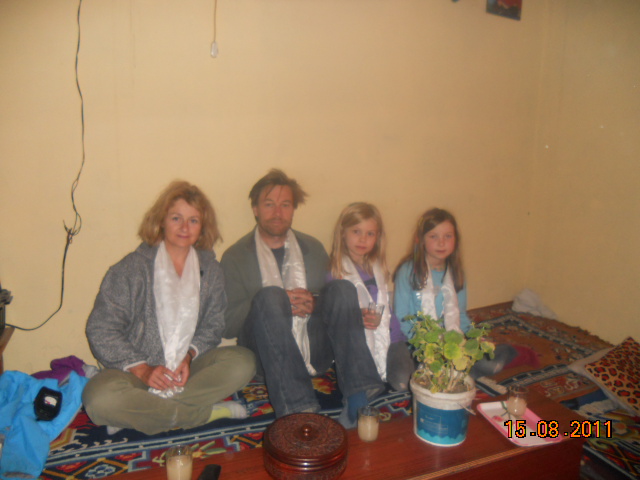


 Electricity was almost non-existant in Kaza.