https://picasaweb.google.com/116253494913081133936/NakoAlbum?authkey=Gv1sRgCOu38LHdsqrCCQ#5672239600461570242
21 August
We left Tabo in the morning, having had a great breakfast seated on cushions on the floor in the very traditional Kunzum guest house, to catch the bus. We walked out of Tabo towards the main road that ran along the valley. There was a large clearing before the main road that looked distinctively like a bus stand, but as well as the few people that were waiting at this spot, there was also a group of ladies waiting on the main road, about 200m away. Not getting any conclusive answers from anyone about where the bus would stop, we stayed in our supposed bus park, but as our co-waiters gradually drifted away, leaving us alone th
 ere, we started to doubt and at the last minute rushed to the group of ladies waiting on the main road, minutes before a bus stopped there. It was relatively full - and as we were all hurriedly picking up our bags ready to load them onto the roof, the conductor advised us to wait a further 10 minutes to catch another bus where we would have a chance of a seat. Not having heard anything about a second bus, we were a little nervous as we let it depart, leaving us alone on the side of the road, but sure enough another bus came by. This one however didn't stop at the road, but turned towards Tabo and ended up in our previously supposed, but now doubted, bus stand. I sprinted the 200m to it to get it to wait, to the amusement of all on the bus, while Jacqui and the girls started to pick up our rucksacks in preparation, but my uncustomary display of athleticism was unecessary as at my panting arrival the driver made signs to indicate that we could stay where we were and they would come back and pick us up.
There were marginally less people on this b
 us, so that at least the girls got a seat, then Jacqui as well, an hour or so later. I managed to get a seat at one point, but gave it up once to a lady with a baby on her back and then a second time to a large lady that was on her way to sitting next to the girls, and certainly would have had them squashed up together. We were all at the back of the bus, so thrown around like a roller coaster again, but as we were not at window seats we were probably insulated from the most terrible sights of vertical drops. The mountainous route from Tabo to Rekong Peo, of which we were travelling a section this day, is described in the Lonely Planet as "the most dangerous in India", but it would be on a subsequent journey that we were to understand the full sense of this expression.
The journey was broken with a stop for breakfast at a roadside dhaba, where Tamsin availed of
a parantha, rolled, patted and cooked before us on the pavement.
We arrived at Nako, a small
mountain village at 3660m of altitude, at around 2:30. After a brief hunt around the few guesthouses to find the cheapest while Jacqui sat at the side of the road g uarding our rucksacks, we celebrated our end-of journey relief with lunch sitting outside at a restaurant that offered an extensive optimistic and enticing menu, but with very little actually available. We heard that there was a lake so set off to find it, ending up navigating through the enchanting maze of the village's winding narrow alley-ways, each enclosed by the adjoining white stone walls of the time-worn houses, and at one point passing, as if laid on to complete our education, the group of three men sat on the ground, working assiduously with hammer and chisel, with a pile of uncut rocks on one side and a growing pile of white stone building slabs on the other. We found th
 e lake, circumnavigated it idly before losing ourselves again in the ascending labyrinth, finally popping out the other side of the village at a road which we assumed was the other end of the road on which we had arrived. As we worked our way back along the quiet road we stopped for a chai, sitting outside Dr Shaksuka's small tea-shop, soaking in the silence and the majestic views over the mountainous interior of Himachal Pradesh. After a delicious dinner of momos, chow mein and spring rolls at a small spitian/Tibetan retaurant, we headed to bed.
 uarding our rucksacks, we celebrated our end-of journey relief with lunch sitting outside at a restaurant that offered an extensive optimistic and enticing menu, but with very little actually available. We heard that there was a lake so set off to find it, ending up navigating through the enchanting maze of the village's winding narrow alley-ways, each enclosed by the adjoining white stone walls of the time-worn houses, and at one point passing, as if laid on to complete our education, the group of three men sat on the ground, working assiduously with hammer and chisel, with a pile of uncut rocks on one side and a growing pile of white stone building slabs on the other. We found th
 e lake, circumnavigated it idly before losing ourselves again in the ascending labyrinth, finally popping out the other side of the village at a road which we assumed was the other end of the road on which we had arrived. As we worked our way back along the quiet road we stopped for a chai, sitting outside Dr Shaksuka's small tea-shop, soaking in the silence and the majestic views over the mountainous interior of Himachal Pradesh. After a delicious dinner of momos, chow mein and spring rolls at a small spitian/Tibetan retaurant, we headed to bed.
2 August
We were up reasonably early with the intention of walking up the hills to the Buddhist stompas that we could see in the elevated distance, before catching a bus out of Nako. We had assumed that the only bus heading towards Rekong Peo, where we wanted to go, would be the bus from Kasa on which we had arrived at around 2:30 the previous day - but unfortunately forgot to check with the locals until the morning, and as I stepped out of the guest house, a bus came though the village (apparently from some other town). If we'd known we probably would have been up earlier to catch it, but as it happens we ended up staying in this beautiful mountain village for a further two days and nights, and did not regret a minute of it. We went 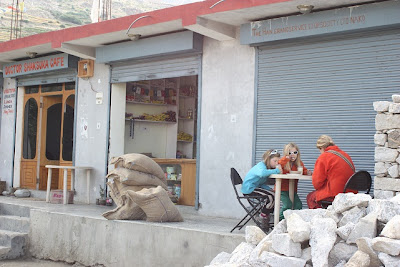 back to Dr Shaksuka's for breakfast and the likeable owner (Dr Shaksuka himself?) was here this time, and we had a wonderful breakfast of fresh curd with the sweetest plums and bananas, followed by chapati and fried egg (chapati and honey for Fia) and lashings of chai. Some other travellers that also had breakfast here, mentioned to us that there was a festival on that day - we checked with the doctor (I assume he wasn't one, but for us he was now), and he confirmed that there was a one day festival being celebrated near the monastery. So we wandered up to investigate. There was already a buzz in the air outside the monastery and the beginnings of people arriving - all in beautiful traditional costume. We took the opportunity to visit the monastery - another that was established by the
 tireless Rinchen Zangpo around 1000 years ago, with a different construction to Tabo but similarly conjuring the images of its historic and ascetic past. A resident friendly monk opened up and showed us around the main chapels, with their ancient statues and murals. The gate to the ancient monastery opened onto a large communal area of the village, at the other end of which was the new monastery, positioned on a ledge such that when you looked at it, it was framed by nothing other than distant mountains and blue sky.
We fell in love with Nako. The beautiful old village, in whose winding stone walled streets we had strolled the previous day, the old monastery whispering its centuries old stories, the silence, the serenity of its inhabitants and the splendour of the barren snow-capped mountains in which it huddled.
 back to Dr Shaksuka's for breakfast and the likeable owner (Dr Shaksuka himself?) was here this time, and we had a wonderful breakfast of fresh curd with the sweetest plums and bananas, followed by chapati and fried egg (chapati and honey for Fia) and lashings of chai. Some other travellers that also had breakfast here, mentioned to us that there was a festival on that day - we checked with the doctor (I assume he wasn't one, but for us he was now), and he confirmed that there was a one day festival being celebrated near the monastery. So we wandered up to investigate. There was already a buzz in the air outside the monastery and the beginnings of people arriving - all in beautiful traditional costume. We took the opportunity to visit the monastery - another that was established by the
 tireless Rinchen Zangpo around 1000 years ago, with a different construction to Tabo but similarly conjuring the images of its historic and ascetic past. A resident friendly monk opened up and showed us around the main chapels, with their ancient statues and murals. The gate to the ancient monastery opened onto a large communal area of the village, at the other end of which was the new monastery, positioned on a ledge such that when you looked at it, it was framed by nothing other than distant mountains and blue sky.
We fell in love with Nako. The beautiful old village, in whose winding stone walled streets we had strolled the previous day, the old monastery whispering its centuries old stories, the silence, the serenity of its inhabitants and the splendour of the barren snow-capped mountains in which it huddled.
The villagers continued to gather for the festival and as we stood in the centre absorbing this beauty, with the warm sun engulfing us, we acquiesced to the inevitable and dropped our plans for leaving Nako that day. The festival lasted all day long with increas ingly large crowds of locals (from Nako but also from a number of villages in the surrounding areas) arriving, greeting each other then taking their places, men typically apart from ladies, either on the ground in front of a small stage at the front, or along a wall at a further distance. The ladies were all dressed in woollen waistcoats, with pyjama-type leg-ins, chunky beaded necklaces, their jet black single plaits of hair down the centre of their backs, elaborate ear-rings and all with their de-rigeur flat-topped Kinnaur (although technically we were in Spiti and not Kinnaur) felt hats, that created a sea of green and grey as you looked across the seated crowd.
 ingly large crowds of locals (from Nako but also from a number of villages in the surrounding areas) arriving, greeting each other then taking their places, men typically apart from ladies, either on the ground in front of a small stage at the front, or along a wall at a further distance. The ladies were all dressed in woollen waistcoats, with pyjama-type leg-ins, chunky beaded necklaces, their jet black single plaits of hair down the centre of their backs, elaborate ear-rings and all with their de-rigeur flat-topped Kinnaur (although technically we were in Spiti and not Kinnaur) felt hats, that created a sea of green and grey as you looked across the seated crowd.
 We also watched the performance in front of us, while equally avidly watching the distinctive community surrounding us. I was particularly captured by a hypnotic rendition from a solo man, singing along with his sitar-like guitar, but the group traditional song and dance performances were also beguiling. Later, there was a dragon dance, with a line of dancers making a giant dragon twist and turn its way through the crowd, lurching towards people making them shriek w
 ith delight. There was no formal seating so we were able to move around, but wherever we drifted, Jacqui, and in particular Fia and Tamsin, would be beckoned over by a group of smiling welcoming ladies and invited to sit with them, where they would smile, share their dried apricots, cuddle and swap hats wit
 h the girls and try to make simple conversation with meaniningful hand signs and facial expressions compensating for incomprehensible words. It was neither the first nor the last time that Jacqui and I reflected on the way that Fia and Tamsin acted as an ice-breaking key into deeper interactions with the locals that we were meeting in our travels - even in less remote areas, travelling with two young children was, although at times limiting, a unique sight that prompted reactions and invitations. People wanted to talk to them, to know about them, to ask them their names, to shake hands, kiss and cuddle them and take photos of them, in a show of unguarded humanity that opened a door for dialogue and trust.
Lunch was served for everyone communal style with huge cauldrons of dahl and rice being cooked over fires with giant size utensils. I had earlier seen people giving monetary donations to the organisers, but when I offered, I was flatly refused with smiles and claps on the back, and though I didn't understand the words they were saying, the meaning was clear: "you are our guest - the pleasure is ours". So we too accepted our paper plates and our ladles of dahl and sat on the ground in the shade, eating with our fingers, then washing afterwards at a water pipe, along with everyone else. The gathering of this tight knit, serene and peaceful community, the warmth of the hospitality that overwhelmed us and the delight of the traditional entertainment engraved the day at the festival in Nako as one of our most vivid and moving memories.
 equally avidly watching the distinctive community surrounding us. I was particularly captured by a hypnotic rendition from a solo man, singing along with his sitar-like guitar, but the group traditional song and dance performances were also beguiling. Later, there was a dragon dance, with a line of dancers making a giant dragon twist and turn its way through the crowd, lurching towards people making them shriek w
 ith delight. There was no formal seating so we were able to move around, but wherever we drifted, Jacqui, and in particular Fia and Tamsin, would be beckoned over by a group of smiling welcoming ladies and invited to sit with them, where they would smile, share their dried apricots, cuddle and swap hats wit
 h the girls and try to make simple conversation with meaniningful hand signs and facial expressions compensating for incomprehensible words. It was neither the first nor the last time that Jacqui and I reflected on the way that Fia and Tamsin acted as an ice-breaking key into deeper interactions with the locals that we were meeting in our travels - even in less remote areas, travelling with two young children was, although at times limiting, a unique sight that prompted reactions and invitations. People wanted to talk to them, to know about them, to ask them their names, to shake hands, kiss and cuddle them and take photos of them, in a show of unguarded humanity that opened a door for dialogue and trust.
Lunch was served for everyone communal style with
 huge cauldrons of dahl and rice being cooked over fires with giant size utensils. I had earlier seen people giving monetary donations to the organisers, but when I offered, I was flatly refused with smiles and claps on the back, and though I didn't understand the words they were saying, the meaning was clear: "you are our guest - the pleasure is ours". So we too accepted our paper plates and our ladles of dahl and sat on the ground in the shade, eating with our fingers, then washing afterwards at a water pipe, along with everyone else. The gathering of this tight knit, serene and peaceful community, the warmth of the hospitality that overwhelmed us and the delight of the traditional entertainment engraved the day at the festival in Nako as one of our most vivid and moving memories.
Around mid-afternoon we finally pulled ourselves out of the revelry, still with the determied intention of not letting the day pass without having climbed up to the buddhist stompas that looked down to us from the mountainside. We set off on a clearly defined path up the mountainside, but as we got higher, the path became ambiguous before it finally gave up on us altogether, and we found ourselves scrambling and hopping across streams in order to pursue our direction to the stompas, still clearly visible above us. Meanwhile, clouds  had been starting to build further down the valley, and in the distance we saw flashes of lightning as the weather too wanted to play its part in what was starting to look like a fairy tale "lost in the forest" scene. The clouds and lightning continued to approach us faster than it looked like we were approaching the stompas, but rather than us start to scramble our way back down, I was sure that we would be quicker to continue the climb up to the top where we would surely find the true path, enabling us to descend much more quickly. True to the script we were enveloped in dramatic thunder and lightning before we made it to the top, drenched and although not admitting it to the girls, a little nervous to have found ourselves up a mountain in a terrible thunderstorm, and trying to contain our own flinches at each ear-bursting crack of thunder lest that we revealed our feelings to the girls. We were at the stompas (which would have been impressive and interesting had we not been pre-occupied with our real life Rocky Horror show), and on top of the world, with an unwanted birds-eye view, not only of the scenery but of the full width of the thunderstorm, enabling us to see the now frequent bolts of lightning shoot from the sky and embed themselves into a mountainside in front of us.
 had been starting to build further down the valley, and in the distance we saw flashes of lightning as the weather too wanted to play its part in what was starting to look like a fairy tale "lost in the forest" scene. The clouds and lightning continued to approach us faster than it looked like we were approaching the stompas, but rather than us start to scramble our way back down, I was sure that we would be quicker to continue the climb up to the top where we would surely find the true path, enabling us to descend much more quickly. True to the script we were enveloped in dramatic thunder and lightning before we made it to the top, drenched and although not admitting it to the girls, a little nervous to have found ourselves up a mountain in a terrible thunderstorm, and trying to contain our own flinches at each ear-bursting crack of thunder lest that we revealed our feelings to the girls. We were at the stompas (which would have been impressive and interesting had we not been pre-occupied with our real life Rocky Horror show), and on top of the world, with an unwanted birds-eye view, not only of the scenery but of the full width of the thunderstorm, enabling us to see the now frequent bolts of lightning shoot from the sky and embed themselves into a mountainside in front of us.
My assumptions were wrong, and we found no signs of a path from the top, so had  no option but to start srambling down, this time heading in the direction of Nako village that we could see in miniature in the distance. Luckily the storm started to subside, and although our descent was more challenging than our ascent, with some huge boulders that we had to navigate and climb over, the fear and drama was now past and we were able to start enjoying the thrill, and sheepishly laugh at the situation we had found ourselves in.
 no option but to start srambling down, this time heading in the direction of Nako village that we could see in miniature in the distance. Luckily the storm started to subside, and although our descent was more challenging than our ascent, with some huge boulders that we had to navigate and climb over, the fear and drama was now past and we were able to start enjoying the thrill, and sheepishly laugh at the situation we had found ourselves in.
23 August
We were up early to catch the early bus to Rekong Peo. By 8:00, having eaten breakfast we were at the side of the road with our rucksacks in a pile, together with a group of punjabi watch sellers from Chandigarh, and various locals. By 9:00 however, we were still sitting there, and were all starting to conclude that there was a problem. None of the locals that we asked had any information and all seemed in the dark as much as we were, until a jeep arrived in the village and two locals stepped out who were able to enlighten us on the happenings up the valley. There was a bus srike - there would be no buses today. We could have tried to get a lift with a passing jeep or car, but in the end opted for yet another night in our beautuful Nako, rather than sitting there potentially for hours waiting, and still not being sure of getting a lift. In fact as the day passed, the explanation of the missing buses evolved - the strike theory was joined by news of a landslide around half way to Rekong Peo, but confusingly, by the end of the day, one bus had passed in eac h direction - so in any case we felt a little more confident for the following day. We checked into a different guest house than we had been staying - slightly more upmarket, and with some space in the room for us to do our school-work which we had opportunistically decided would be our main task for the day, and got stuck into a maths lesson while Jacqui did some clothes washing. It was the first time we couldn't find anybody willing to do the laundry for us, and our limited travelling wardrobe lasts us a few days only before we need to wash. Jacqui, unwisely revealed that, having been starved of any domestic tasks, had quite enjoyed the experience.
We had a lunch of momo's and chow mein up on the hotel balcony (this hotel ran an extremely good and thriving little restaurant), before heading off for another walk in the mountains - we had heard one or two vague indiciations that if we headed up to the stompas (not the same as the ones we had conquered the previous day) that were just about visible on a pass in the distance, you could then walk all the way along the ridge which circled the village, with views on the other side over to Tibet. It was around a 4 hour walk we were told. We headed off armed with waterproofs as rain clouds were around, albeit less threatening than the day before. It was a steep cl imb for the first hour up to the pass, on a beautiful rocky narrow path that clung around the contours of the face of the mountain. A rain cloud edged past us, so that for a while we had a strange combination of hot sunshine and sparse but large drops of rain. "I think we had better head back, we don't want to get caught in a thunderstorm again" said Fia, putting on her wise and responsible tone of voice and getting nods of approval from her sister, both cunningly trying to exploit their parents embarassment over bad walking decisions taken the previous day, in a vain hope of calling off this tiring expedition. Stopping for a quick snack at the top, we saw a young English couple whom we'd met in the village while they were hanging around waiting for a bus in the other direction. They had set out on the same walk as us but decided to turn back when it started raining.
 h direction - so in any case we felt a little more confident for the following day. We checked into a different guest house than we had been staying - slightly more upmarket, and with some space in the room for us to do our school-work which we had opportunistically decided would be our main task for the day, and got stuck into a maths lesson while Jacqui did some clothes washing. It was the first time we couldn't find anybody willing to do the laundry for us, and our limited travelling wardrobe lasts us a few days only before we need to wash. Jacqui, unwisely revealed that, having been starved of any domestic tasks, had quite enjoyed the experience.
We had a lunch of momo's and chow mein up on the hotel balcony (this hotel ran an extremely good and thriving little restaurant), before heading off for another walk in the mountains - we had heard one or two vague indiciations that if we headed up to the stompas (not the same as the ones we had conquered the previous day) that were just about visible on a pass in the distance, you could then walk all the way along the ridge which circled the village, with views on the other side over to Tibet. It was around a 4 hour walk we were told. We headed off armed with waterproofs as rain clouds were around, albeit less threatening than the day before. It was a steep cl
 imb for the first hour up to the pass, on a beautiful rocky narrow path that clung around the contours of the face of the mountain. A rain cloud edged past us, so that for a while we had a strange combination of hot sunshine and sparse but large drops of rain. "I think we had better head back, we don't want to get caught in a thunderstorm again" said Fia, putting on her wise and responsible tone of voice and getting nods of approval from her sister, both cunningly trying to exploit their parents embarassment over bad walking decisions taken the previous day, in a vain hope of calling off this tiring expedition. Stopping for a quick snack at the top, we saw a young English couple whom we'd met in the village while they were hanging around waiting for a bus in the other direction. They had set out on the same walk as us but decided to turn back when it started raining.
We headed on the path they had come from - it was stunning - with views of what must have been the Tibetan snow capped peaks in front of  us, as well as a few of the snaking roads clinging to the mountain sides. Somewhere down there was the old Hindu-Tibetan highway which had been used for trade to the east for centuries, and we thought also of the many Tibetans who had excaped from their homeland on foot, on a path much like ours, to take refuge in India, many in Dharamsala. After walking another hour or so, we started to conclude that our path was not approaching the ridge that we had hoped to walk along, and that if we continued we risked a premature entry into Tibet - so we left the path to head directly up the mountain to try to find the required path. After an hour of exhausting steep uphill, the ridge of the mountain, which had looked within touching distance from below, did not seem any closer, and we compromised for another half-path to get back to the original pass to get back to Nako.
It became competitive on the way down, and developed into a race - Tamsin and Daddy vs Fia and Mummy, and we were back down at Nako, panting, in around half an hour - and as it happens we were glad of the speed, because just as we arrived, the heavens opened for several hours of heavy rain.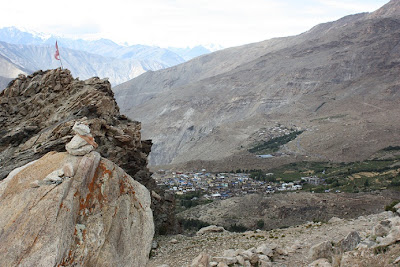
We spoke to a couple from Barcelona who had also set out walking in the morning on the same route. They had spent the whole day - they had a great walk but had clearly not found this elusive path that had been referred to, and we came to the conclusion, after our two days of walking in the mountains around Nako, that the word "path" in local vocabulary represented something more akin to an attitude than something of a physical nature. In the evening over dinner, We learnt a new card game from Stefan and Stefanie - two germans that we had joined for dinner. We had worn thin our portfolio of two card games (three if you include "Snap") so were delighted.
 us, as well as a few of the snaking roads clinging to the mountain sides. Somewhere down there was the old Hindu-Tibetan highway which had been used for trade to the east for centuries, and we thought also of the many Tibetans who had excaped from their homeland on foot, on a path much like ours, to take refuge in India, many in Dharamsala. After walking another hour or so, we started to conclude that our path was not approaching the ridge that we had hoped to walk along, and that if we continued we risked a premature entry into Tibet - so we left the path to head directly up the mountain to try to find the required path. After an hour of exhausting steep uphill, the ridge of the mountain, which had looked within touching distance from below, did not seem any closer, and we compromised for another half-path to get back to the original pass to get back to Nako.
It became competitive on the way down, and developed into a race - Tamsin and Daddy vs Fia and Mummy, and we were back down at Nako, panting, in around half an hour - and as it happens we were glad of the speed, because just as we arrived, the heavens opened for several hours of heavy rain.

We spoke to a couple from Barcelona who had also set out walking in the morning on the same route. They had spent the whole day - they had a great walk but had clearly not found this elusive path that had been referred to, and we came to the conclusion, after our two days of walking in the mountains around Nako, that the word "path" in local vocabulary represented something more akin to an attitude than something of a physical nature. In the evening over dinner, We learnt a new card game from Stefan and Stefanie - two germans that we had joined for dinner. We had worn thin our portfolio of two card games (three if you include "Snap") so were delighted.


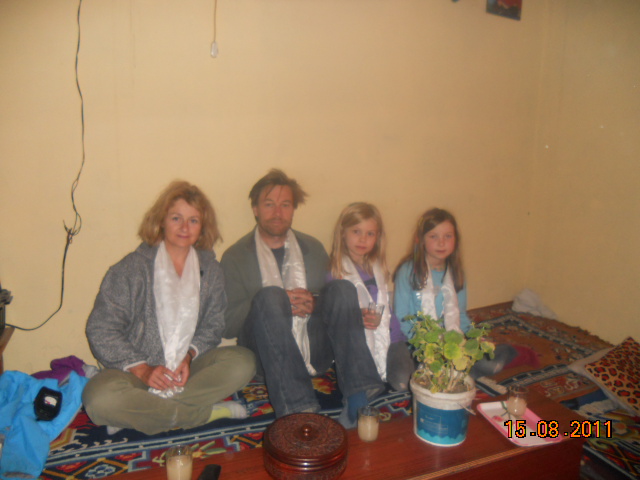


 Electricity was almost non-existant in Kaza.